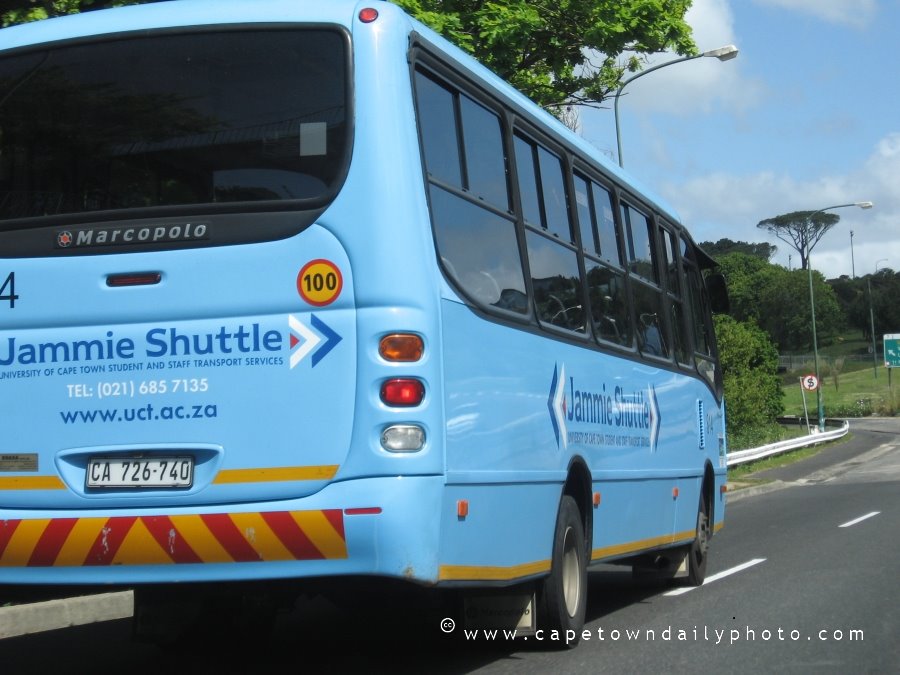
On any given day you're likely to see a few of these Jammie Shuttles driving along the M3 near the University of Cape Town. This free shuttle service is reserved for staff and students of the university, and transports them between residences, campuses and certain public transport facilities and parking areas in the vicinity.
What I didn't know is that these buses are also available for hire to outside organisations in Cape Town. I wonder how many people we'd need to get together to qualify as an "organisation"? Could be fun transport for a day at the beach... ;-)
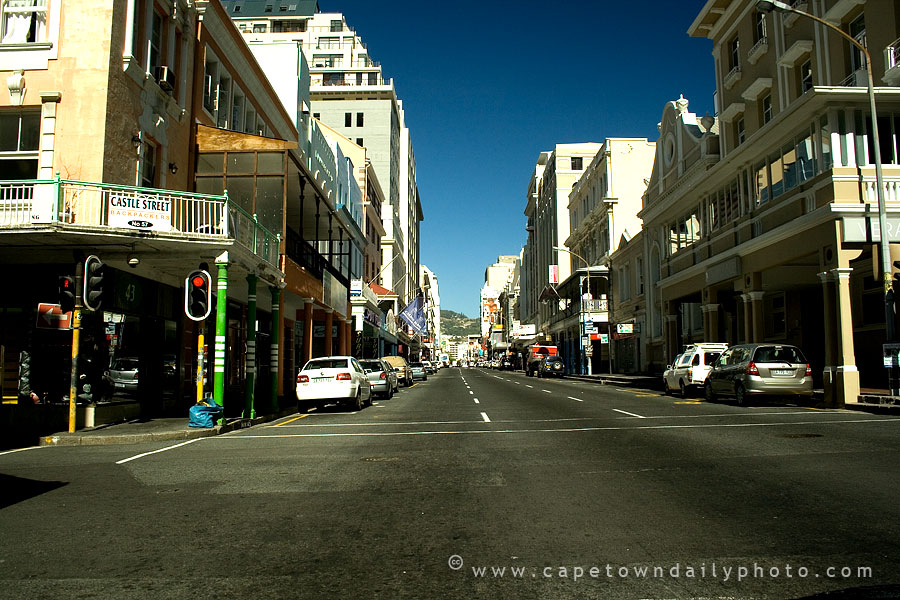
Long Street is one of my favourite streets in Cape Town. It's filled with restaurants, bars, backpackers' hostels, eclectic shops and charming architecture; and no matter what time of day or day of the week you're in town, you'll always find life and activity here.
If you look carefully at the parked cars in the photograph, you might notice that it's a one-way street; Long Street stretches for more than 20 city blocks (3.8km), and is one of the oldest roads in Cape Town. If you're interested, read more about the residents and landmarks of Long Street.
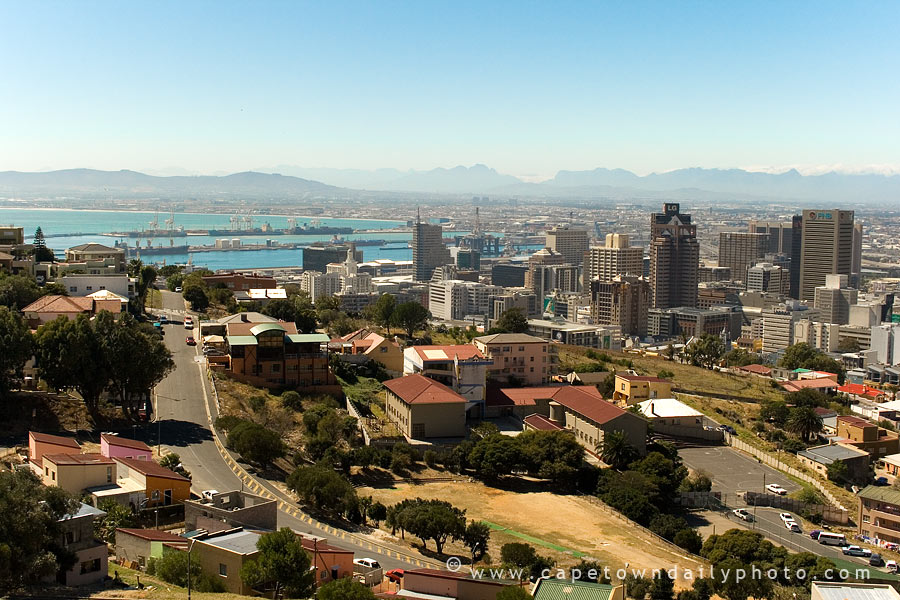
Today, a panoramic view of the city and harbour, taken from the slopes of Signal Hill... isn't it lovely?
There's been a decided chill in the air the last few evenings, and I suspect that summer is about to take its leave. Temperatures are still in the mid to high 20s, but I think in around two to three weeks' time we can expect them to start dropping a little.
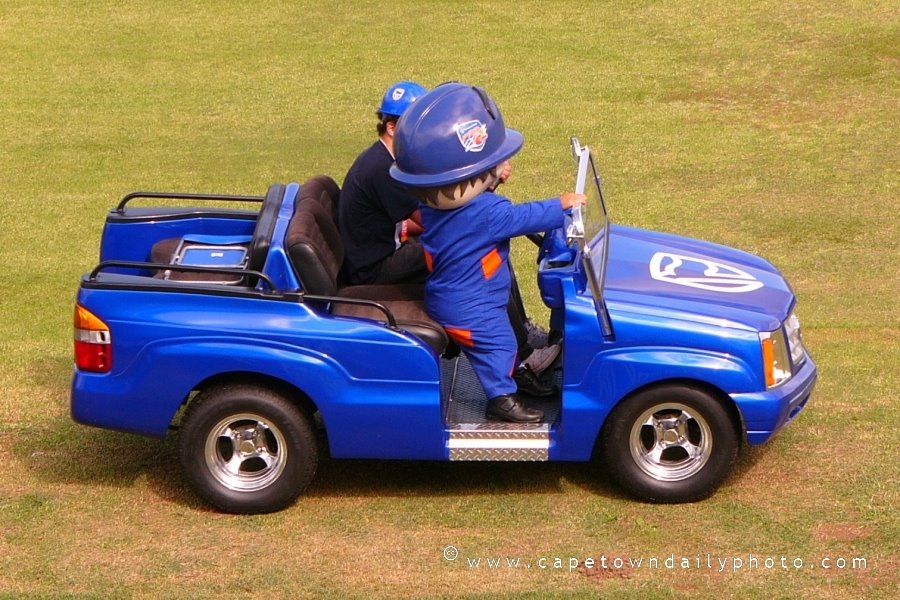
I went to a Standard Bank Pro20 cricket match in Paarl today (I was going to be live-blogging the game) - unfortunately we had some rain in Cape Town this morning, and so the field was too wet for any play to take place. This is the Pro20 mascot, Hardy, who was driven round and round the field in his blue buggy, while the crowd waited to hear whether there'd be a game or not. Isn't he too cute for words?
While I was there, I bumped into one of our legendary cricketers, Jonty Rhodes, who is now the fielding coach for the SA team; but I was so distracted by my thoughts that I didn't realise why he looked so familiar until AFTER he'd walked past. Have you ever had one of those "duh" moments? Um, Jonty, if you're reading this, next time I see you I'll say hello like I mean it. :-)
Rick's Cafe Americain is one of the most delightfully decorated establishments around Cape Town, full of eclectic light fittings, comfy couches, old-style movie posters and brightly-coloured cushions.
I haven't actually had a meal at Rick's yet, only drinks, but I hope to rectify that soon - they specialise in tapas, gourmet burgers and Moroccan dishes. You can see a few photos of the interior here.
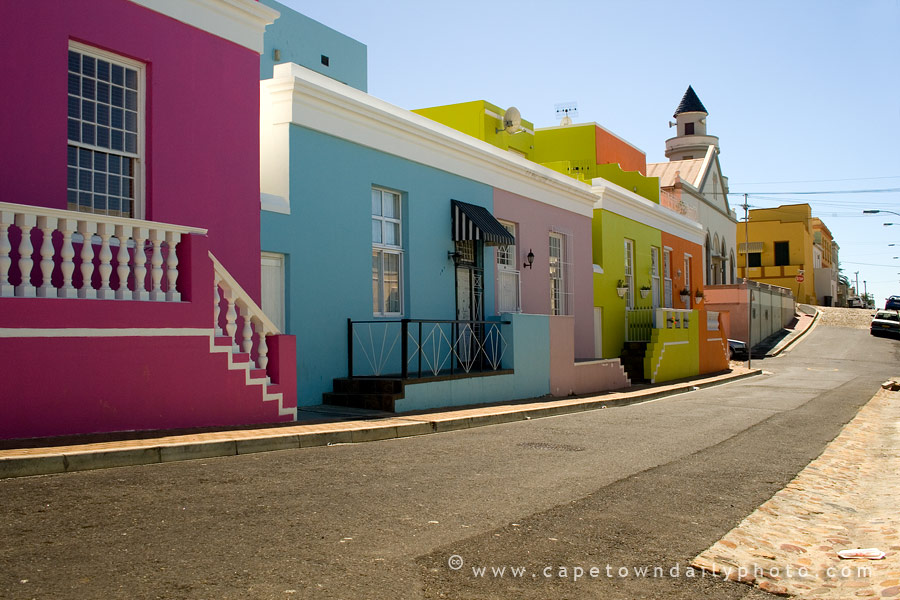
About a week ago we posted a photo of a street in the Bo-Kaap. Here's another part of the Bo-Kaap, with even more colourful houses than those in the previous post.
Many of the current residents of this area are descended from the Indonesians, Malaysians, Sri Lankans and Indians who were brought to the Cape as slaves in the 1700s. The Bo-Kaap is also known as the "Malay Quarter".
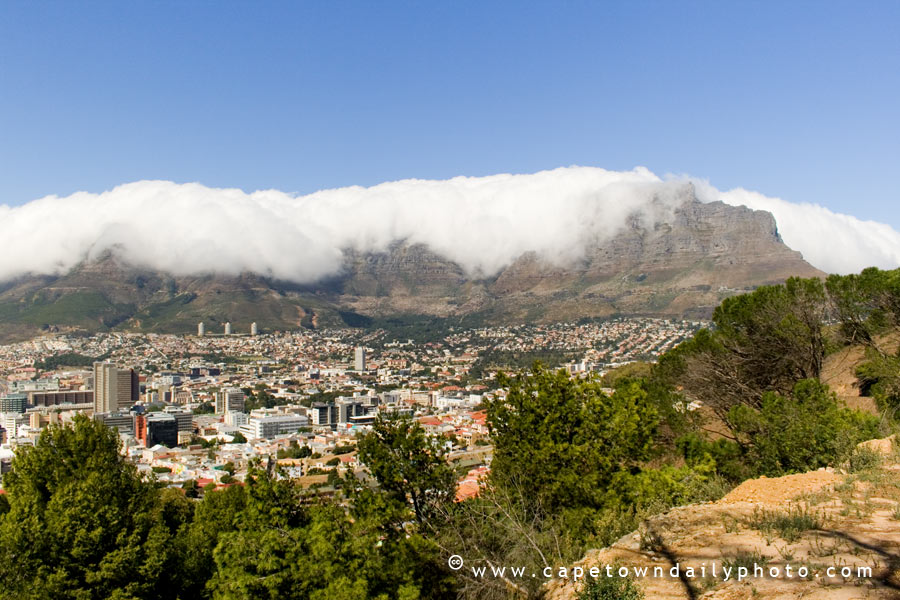
That's Table Mountain's famous table-cloth - often formed on summer days by thick white cloud spilling over the top and down the front of the mountain. It might be a gorgeous day in the city, but trust me, when that cloud comes over, it gets bitterly cold on top of the mountain. The other thing to remember is that when the cloud comes over, it becomes very difficult (nearly impossible, in fact) to find your way around on top of the mountain. Visitors are always warned: take warm clothing if you're going up the mountain, no matter how hot it is when you start up from the bottom - that way, if you do get lost on top of the mountain, at least you'll be able to keep warm until the cloud lifts.
In case you missed it, read our story of how not to climb the mountain here.
Thank you! Yes, you! We were awarded the title of Best South African Travel Blog at the SA Blog Awards ceremony this evening - and we couldn't have done it without your support. We were up against some *real* journalists in this category too, so we're very pleased to have won, as you can imagine. :)
Thanks to the organisers for all the behind-the-scenes effort, to the sponsors Warwick Wine and Stodels Nurseries for our prizes, and to Butlers Pizza for the great food. Congratulations to all the winners!
Again, thank you - for reading, for commenting, for supporting, and for voting.
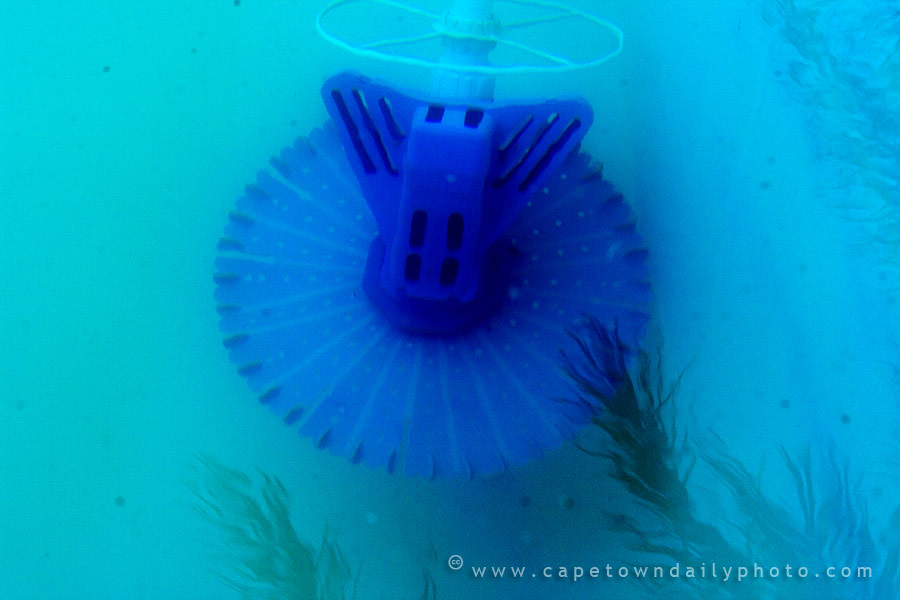
It may not be a Kreepy, but it's still crawly. This odd-looking creature of the deep is in fact a Baracuda, and we discovered it in the swimming pool at our new house (which we finally moved into today).
The first automated pool cleaner, the Kreepy Krauly, was invented in South Africa in 1974, by Ferdinand Chauvier, a hydraulics engineer from the then Belgian Congo. Since then, a number of other brands have been developed, of course - one of which is the Baracuda, pictured here doing its job gobbling up all the sediment in our pool. (If you're interested, you can read the whole Kreepy Krauly story here.)
178 blogs are participating in today's theme day; visit them by clicking on the links below:
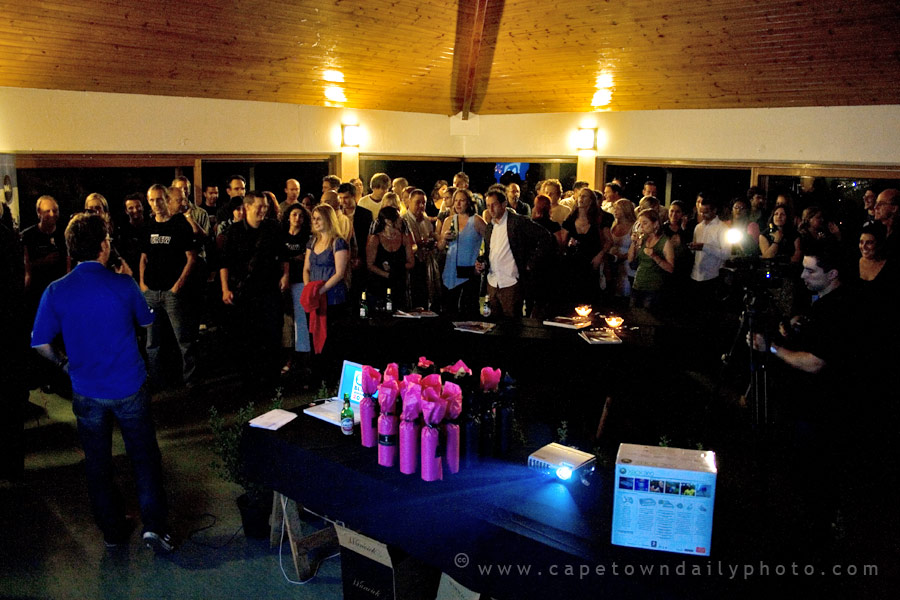
Tonight's GeekDinner was held at Greens - a restaurant in Plattekloof - about 20 minutes' drive from the city. This really was an awesome venue - the service was great, the food brilliant and the ambience just perfect for this GeekDinner, Garrulous Grape.
Aside from the restaurant and interesting technology talks, the evening was made even more enjoyable by Perdeberg wines, who sponsored a couple of cases of red and white. Perdeberg is currently running an innovative competition, called Clink to Win. They're giving away a whole lot of wine each month - apparently one lucky guy recently won 156 bottles of Perdeberg wine in one go! I bet he suddenly has a whole lot of new friends... ;-) Visit www.clink-to-win.co.za to find out how to enter.
This house, and many others like it, can be found just a few kilometres from the Bo-Kaap area, in the quiet neighbourhood of Tamboerskloof. Situated between the city proper and Lion's Head, Tamboerskloof is filled with quaint Victorian houses, most of which were built between 1895 and 1905.
At that time the city centre simply couldn't house the large numbers of people arriving from Europe and the northern parts of South Africa, and so the farms on the slopes of Lion’s Head had to be sub-divided to make space for the exploding population.
Ironically known by many as the "Black Taxi", these minibus taxis aren't black at all. The reference to "black" is because for the most part they're black-owned and mostly transport our black population to and from their respective places of work.
Generally one finds taxi ranks near large shopping malls, train stations and in certain suburbs. These taxis drive predefined routes and pick passengers up and drop them off along this route. Never having used such a taxi, I'm not completely sure of how the cost of the trip is determined - I don't believe there's a flag (since passengers are getting on and off all along the route) so I imagine it's up to the discretion of the driver or his assistant.
Minibus taxi drivers are notorious for not obeying traffic laws. They're almost a law unto themselves, passing on the yellow line, pushing their way between cars to the front of the queue, and driving faster than perhaps they should be. Normal cars play the chicken game with taxis, to see who will back down first and generally unless the car clearly has the upper-hand, the taxi wins.
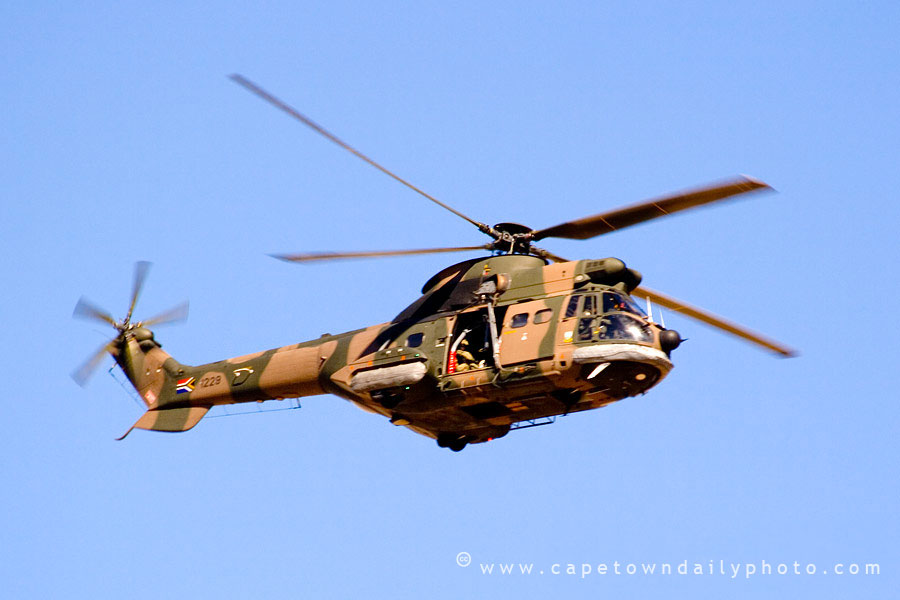
The first Puma prototype flew for the first time in 1965. This helicopter was developed in France by Aérospatiale to be a mid-sized highly versatile aircraft for use by the French Army. The South African defence force has used the Puma for about as long as I can recall, and today we still regularly see them flying the skies of Cape Town.
The Bo-Kaap (pronounced something like "Boor Carp", and meaning "Upper Cape") is a quaint and very colourful area, situated on the slopes of Signal Hill. The streets - a number of them still cobbled - are narrow and extremely steep (not the kind of place you want to go for your driver's licence test, in other words). Most of the houses here are painted in bright, bold colours, giving the suburb real character.
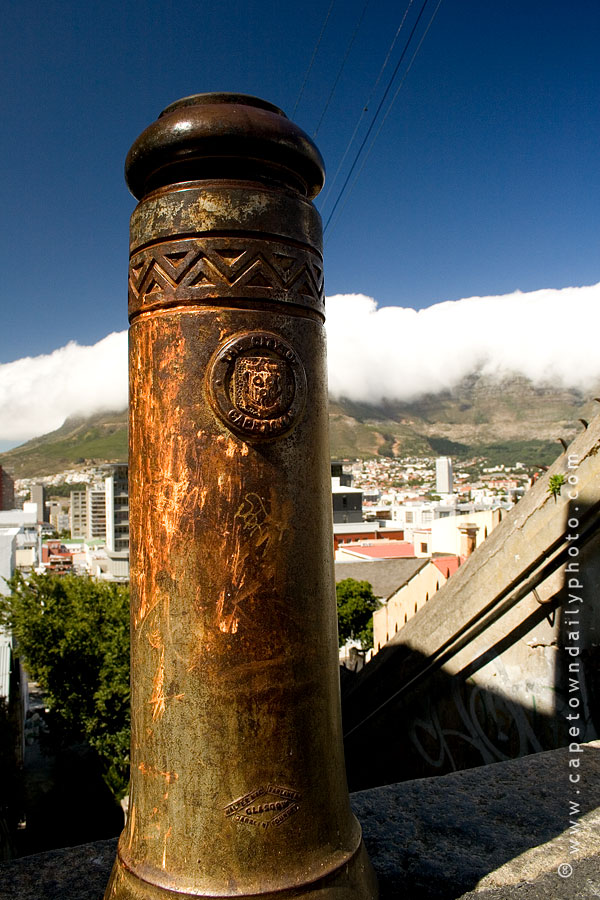
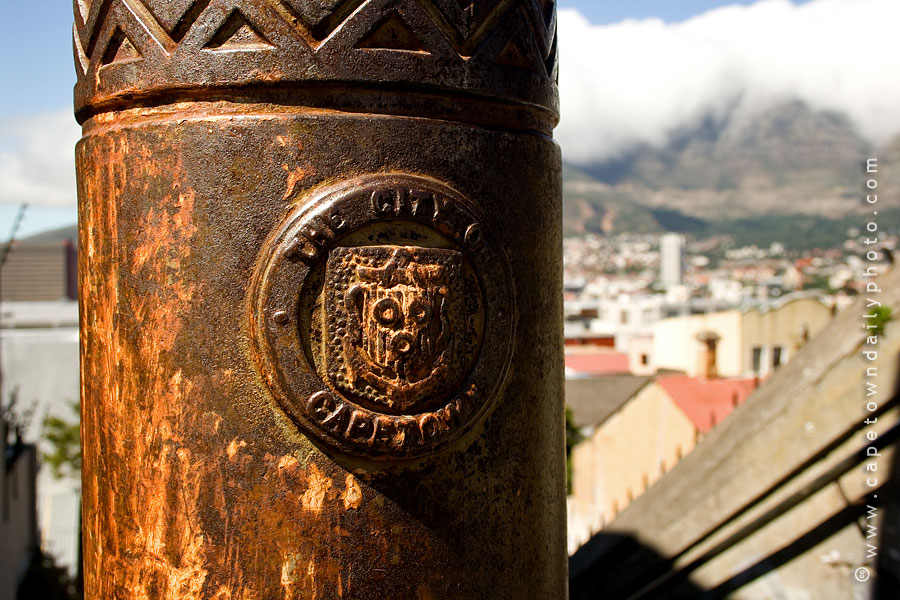
In our previous post we asked if whether or not you were able identify the object in the photo, and the place where the shot was taken. If you noticed that Devil's Peak formed part of the photo's background then you may have guessed that the area is Bo Kaap, and that the object of the photo is (what I believe to be) a bollard made many many years ago in Glasgow, Scotland (see the inscription on the enlarged photo).
At the time I never gave this bollard a second thought, but considering it now, I wonder who placed it up top of this flight of stairs, and where exactly they got the it from. Perhaps it's from the era when the current Cape Town city was still under water, forming part of Table Bay? ;)
We'll do a more informative post about this area in a day or two, but for the meantime do you have an idea of (a) where this photo was taken and (b) what the subject in this photo is? If you're familiar with Cape Town then I believe there should be enough in the background to help you discover the location.
Kerry-Anne is away this week, attending the 2nd Annual New Media Marketing Conference, held by IQPC in Johannesburg. So, for the next few day's I'm on my own, looking after CTDP, with no Internet connectivity at home, and trying my best to make sure that my grammar is up to her standard. She's so demanding in that way. ;)
Cape Town, known many years ago to Europeans as Cape of Storms, was first navigated by Europeans in 1488. Bartolomeu Dias, a Portuguese explorer, was commissioned by King John II of Portugal to find a shipping trade route to Asia via the southern tip of Africa. Europe was desperate for such a route because of the dangers of the land route and the high cost of negotiations with middle-men in countries on route to India.
On his initial voyage Dias never actually landed anywhere near Cape Town. For thirteen days his ship was caught in a raging storm, after which he laid anchor at Mossel Bay (a few hunderd kilometers up our east coast). When Dias eventually turned back and found Cape Town, he named it Cabo das Tormentas, the Cape of Storms. King John II of Portugal later renamed it to Cabo da Boa Esperança, meaning Cape of Good Hope, because it opened up a sea trade route to India and the rest of Asia.
Note: This really really big propeller can be found outside the Mediterranean Shipping Company's offices in Martin Hammerschlag Way.
De Hel is translated by Google Translate as Hell - the place of fire and brimstone. I'm not sure why it got this name, although perhaps it's because of the dense vegetation that leaves (*groan*) one strangely disoriented.
This afternoon Kerry-Anne and I went to seek out geocache GCTMP6 along this walking trail in Constantia. After quite some walking and fighting our way along a path that was somewhat overgrown in parts, we found the cache hidden among the roots of a huge tree. Although moderately tiring, the walk was great - the greenery and untouched natural forest was really very beautiful.
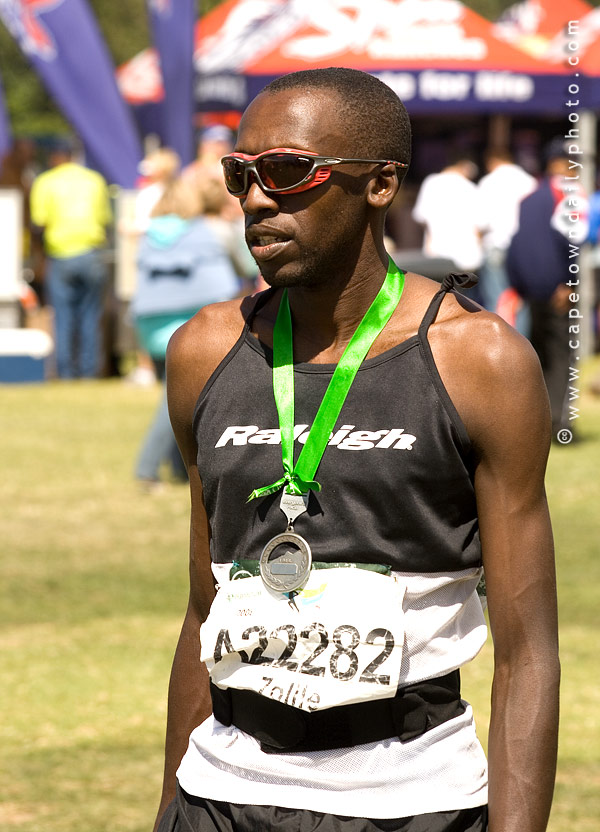
Today was the annual 56km Two Oceans marathon, sponsored by Old Mutual, a large insurance company. It's been suggested that this ultramarathon is the most beautiful in the world, taking runners on a tour of the Cape Peninsula, past both the Atlantic and Indian oceans.
For some reason I'd always had the impression that anyone taking part in a marathon would be slim and look super-fit, but this was not so - there were plenty of people who were slightly or moderately overweight. There were also old people and young people, black and white, South Africans and internationals, making for really colourful and diverse scenes.
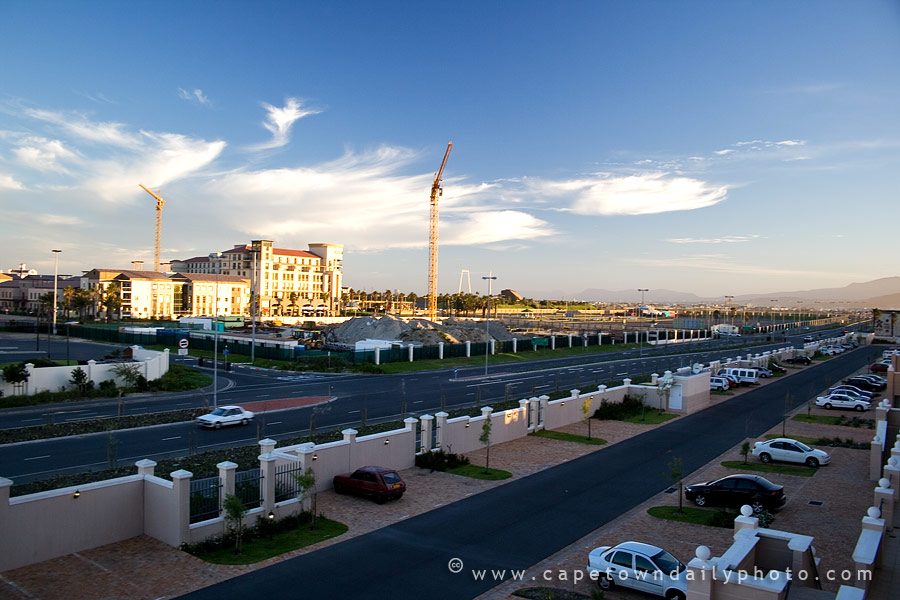
It appears as though the backyard of our temporary home at Century on Lake has become a construction site. I'm not sure what's being built - perhaps a shopping park or offices or maybe even another block of flats.
To give some perspective, right in the centre of this photo, in the distance, is the Ratanga Junction theme park. Slightly to the right (almost out of sight) is the temporary home of Madame Zingara's tent, "a place of sensual indulgence, baroque splendour and sheer fantasy". If you're visiting Cape Town, you really have to visit Madame Zingara's - it's quite an experience... and while you're there, say hello to Marcel, a friend, and the most awesome magician we know!
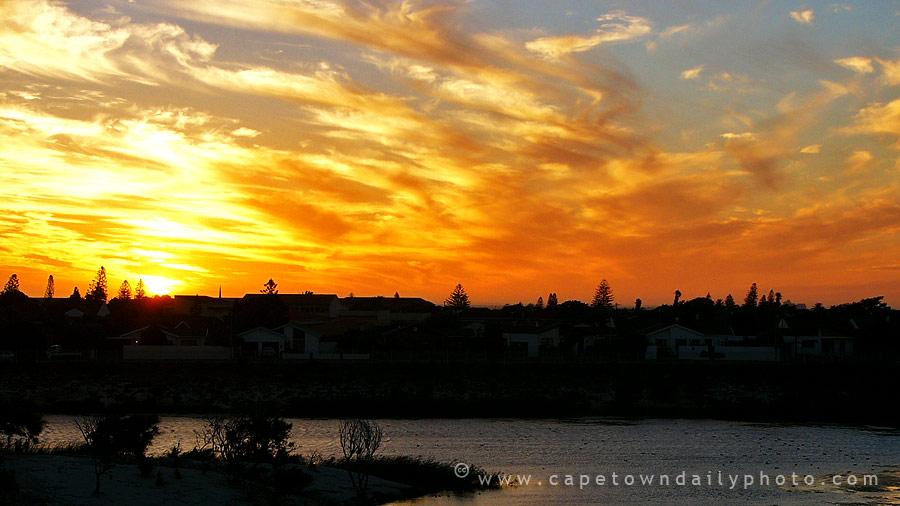
Last night's wet weather left Cape Town by morning and today only remnants of those rain clouds remained. These, lit up across the sky, made for a scene worthy of canvas but impossible to capture in all its majesty.
Watching the sun rise and set from our balcony is spectacular when the air is quiet and the only sounds are those of the ibis, falcon and seagull. It's so calming to watch the ducks and geese paddle, chase each other and forage for food in the dam below. This really is an awesome place to live, and I'm a little sad that we'll be leaving in a just over a week.
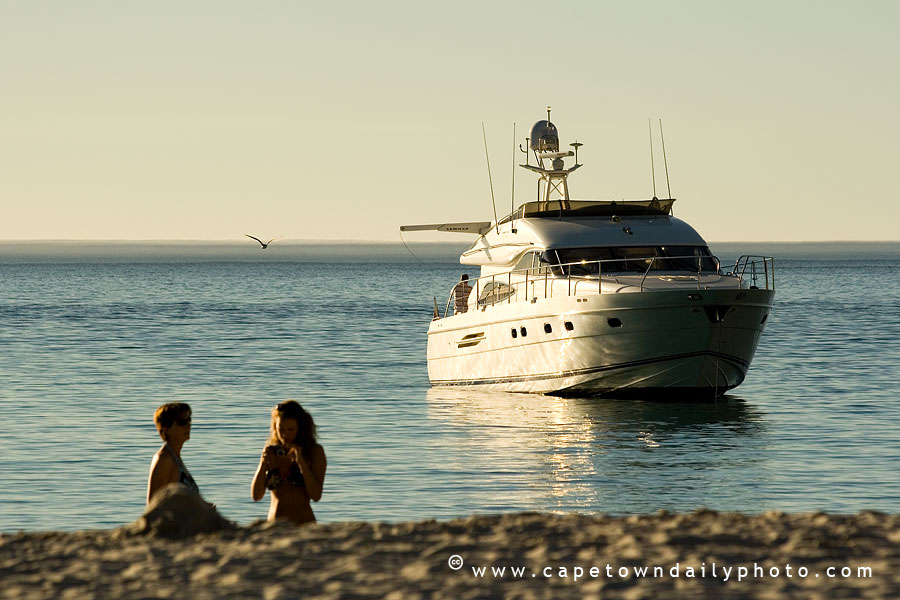
Well, perhaps not famous, but having a good deal of money, certainly. I've seen this boat parked just off the beach at Clifton a few times. On this particular afternoon I watched for several minutes as a rubber dinghy towed a rather unsteady skier backwards and forwards. The beach is relatively well sheltered from the wind, so I guess it makes a pretty good place to learn to ski.
I remember that I tried skiing once many years ago. I did reasonably well until I ended up with a ski on either side of the boat's wake. I quickly had to make a decision - either let go of the ski rope or learn the splits in a hurry. I still can't do the splits. ;)
These two ladies might look chilled out there on their lilo, but let me tell you, they are in fact CHILLED, if you sense the difference in my meaning.
The water at Clifton is just a little on the icy side. When I say "a little on the icy side", I mean of course that you might lose a toe if you step too hard on the way out. Durbanites, who are accustomed to the bathtub waters of their own coastline, are often taken by surprise by this, and can usually be quite easily spotted: they're the ones wearing 8mm wetsuits at Gordon's Bay (which, in case you're wondering, actually has very swimmable water indeed - by Capetonian standards, anyhow).
Clearly these ladies are braver than I - the longest I've managed to stay in the water at Clifton is about 30 seconds. And that was just up to my ankles. Nearly lost a toe too, on the way out...
As autumn wends its way towards us and the days get shorter, our beaches will slowly empty, with the probable exception of adrenaline-starved surfers, hardy beach addicts and the odd romantic couple. Cooler weather seems to have sprung upon us quite unexpectedly, with evenings now requiring warm clothing to ward off the chilly breeze.
Summer always seems to end far too abruptly - and I'm pretty sure that it's getting shorter each time around! So, as we head towards winter you should expect to see a few more beach pictures, as Kerry-Anne and I make as much use as possible of the few remaining warm days.
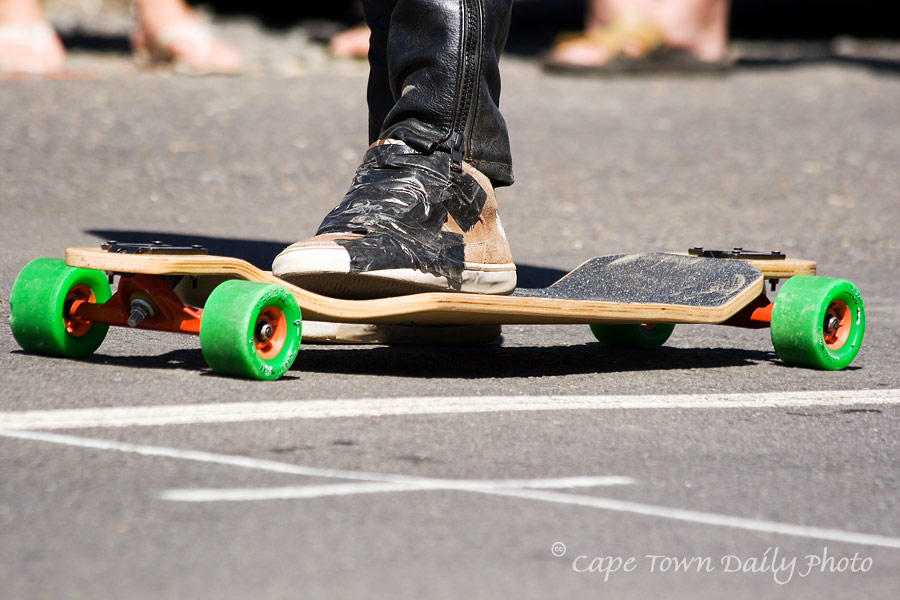
I took a drive out to Durbanville today where the IGSA "Fair Cape Downhill Challenge" skateboard and street luge competition was being held. I'm not sure exactly what speeds were reached this weekend, but it's reported that 103km/h and 117km/h were expected for skateboarders and street luge respectively. Although the bales of hay lining the road help to prevent serious injury, I can imagine that hay is still pretty hard if you fly into it at over 100km/h.
After two days of tough competition in the baking sun, Michael Zietsman came out tops with Anton Pratt, Richard Dweza and Tibor Hery following close on his wheels. Congratulations guys, you were cooking! ;)
The annual floats procession along Adderley Street is just one of the fundraising events organised by the University of Cape Town's RAG committee.
Students work in teams to design and build floats based on a theme (this year's theme was "Homegrown Heroes"); the floats are then driven up and down Adderley Street in a colourful, energetic and wonderfully noisy procession. Each student has a collection box, and as they walk, run or... um... dance alongside their floats, they creatively request donations from the spectators lining the streets. All the money they collect goes to SHAWCO, a student-run organisation that concentrates on youth and community development programmes.
We took a LOT of photos today - visit Cape Town Daily Photo Extras to see more than 100 photos of the floats procession.
If you enjoy Cape Town Daily Photo, please don't forget to vote for us in the SA Blog Awards - click on the SA Blog Awards logo at the top right, and then hit the Submit button at the bottom of the voting page. There are just a few days of voting left!
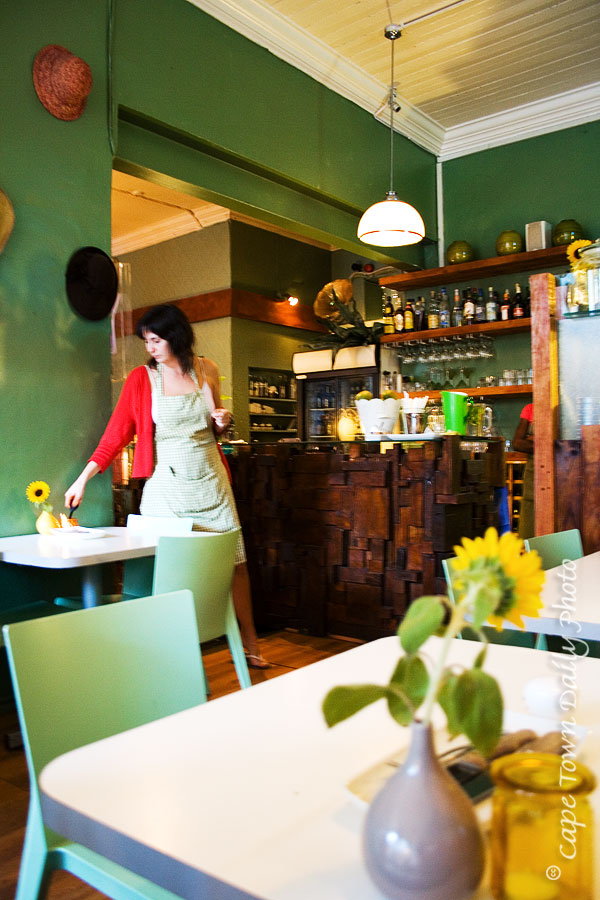
Not just their milkshakes, actually - their burgers too; and not just the boys either - apparently Salma Hayek (who, according to my sources, is definitely a girl) was quite taken with Royale's gourmet burgers and milkshakes too. This shot was taken inside Royale Eatery, a funky diner-style restaurant on Long Street, renowned for their huge gourmet burgers and heavenly milkshakes.
We had our burgers with sweet potato chips, which turned out to be an excellent choice; Paul had a Honeycomb milkshake, which was so good, I tried to steal it while he wasn't looking; and I had a Plum and Grape milkshake, upon the recommendation of our delightful - and very pretty - waitress. (Paul mentioned in passing that if he were a single guy, he's spend a lo-o-o-ot of money at Royale, 'cos they've got some of the loveliest waitresses in town.)
Most lamp-posts in Cape Town are adorned with posters advertising shows, exhibitions, concerts and other events - at least, it certainly seems that way.
We thought we'd post this one today: firstly, because the colours are rather pretty, and secondly, in case you're in Cape Town, and didn't realise that the UCT Rag Floats Procession was taking place this weekend.
And if you're not in Cape Town, don't worry - we'll make sure we get up early enough to get some photos of the floats as they make their way up (or is it down?) Adderley Street on Saturday morning. Stay tuned. ;-)
This unusual view of Table Mountain (enlarge the picture and you'll be able to see the cable-car station at the top) was taken from one of the highest roads in Camps Bay.
I'm sure we've mentioned before that the beachfront area in Camps Bay is one of our favourite parts of Cape Town - particularly in December, when the streets are jammed, the beaches are full of holidaymakers, and the restaurants are packed with beautiful people.
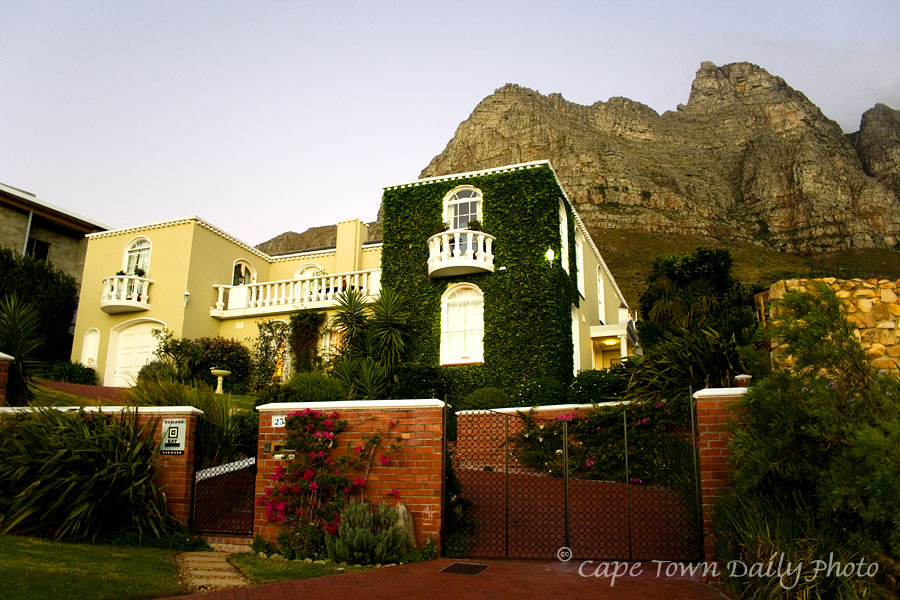
The houses aren't too shabby either, as you might be able to see from this shot. Camps Bay is an affluent neighbourhood, and a high proportion of the properties here are owned by foreigners.
In fact, a UK woman has apparently just paid R44 million (that's around $5.6 million or 3.6 million Euros) for a double-storey building on the beachfront - and she plans to demolish it!
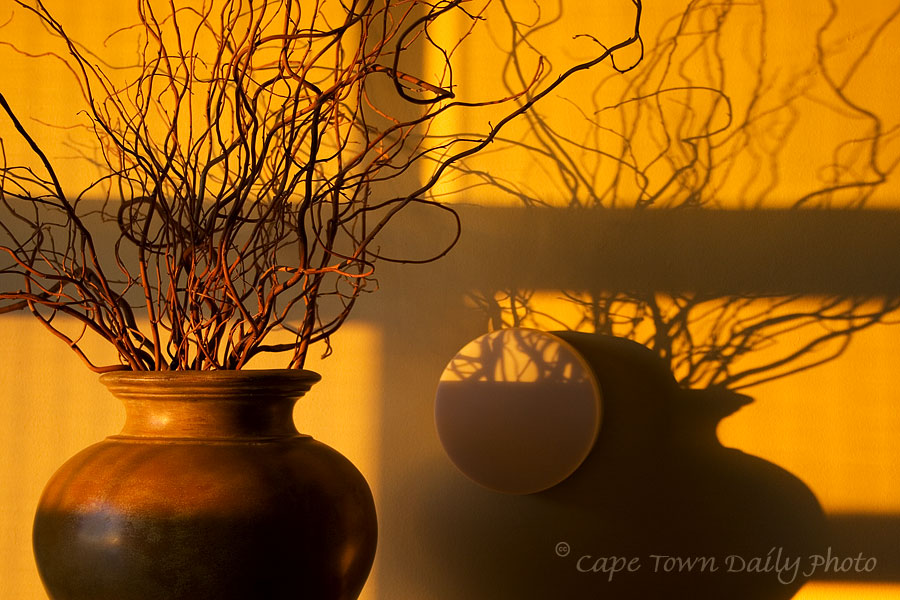
As mentioned in a previous post, we're living in a furnished loft apartment for the month. We had a friend over for dinner tonight - his comment was that the décor makes the flat look homely. Don't you just love this pot - it's a really nice idea of how to add volume and atmosphere to a holiday flat.