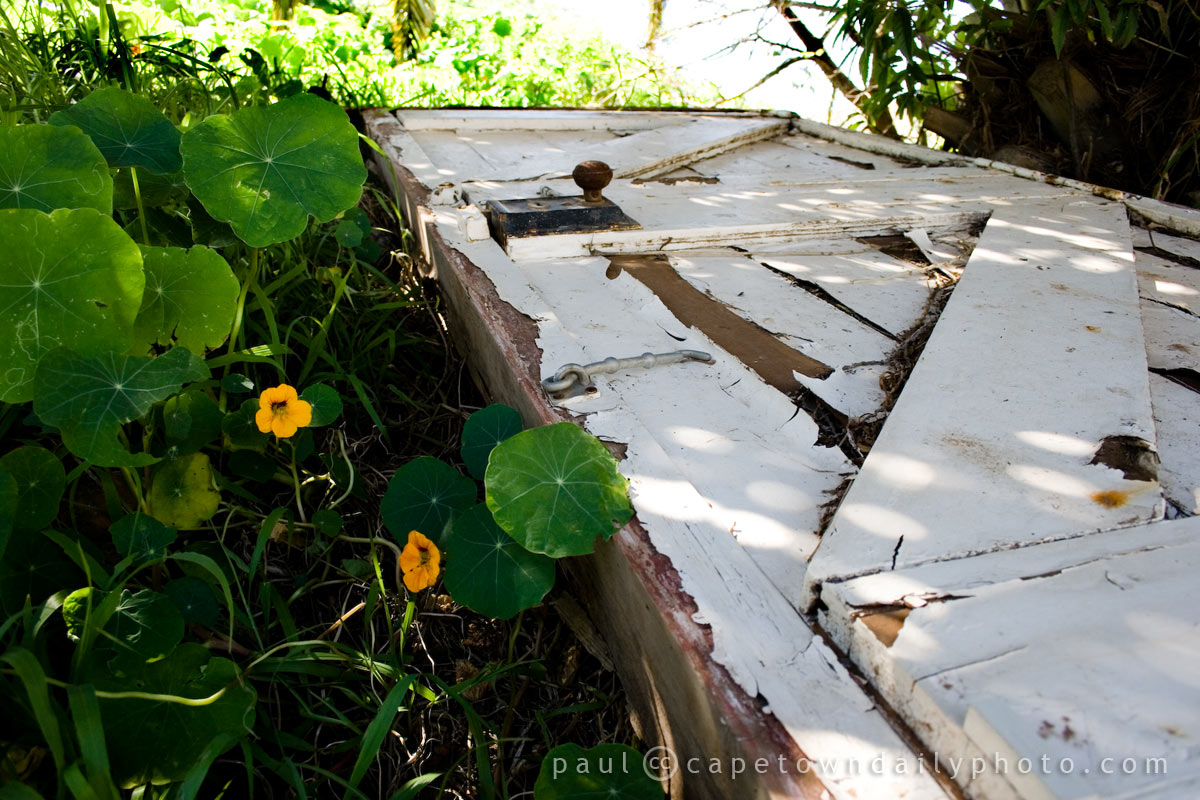
Often when I see an old object like this door I wonder what history it has seen. Isn't it interesting to consider all the people that may have turned and pulled on the door knob? Don't you curiously consider what led it to be removed from its doorway and left lying on this grassy patch?
On a completely different subject... notice the Nasturtium flowers to the left? It was the weirdest thing ever when I discovered one day that Kerry-Anne likes putting these into salad! I guess they do act as a beautiful garnish... but for her it's not only about the decorative appeal - she enjoys the taste too! I wouldn't be surprised if next I find her picking daisies for a quick stir-fry!
Today is the City Daily Photo Theme Day, an event held on the first day of each month to encourage you to visit some of our sister City Daily Photo blogs. We haven't taken part in Theme Day for several months now, but as I type it's 01h05 in Cape Town and can you believe it, we've actually managed to get an appropriate photo to suit the theme day topic and we've managed to post it on time! We so rock this month!
As promised, here's another photo taken in Joostenbergvlakte. The suburb has an odd mix of large, lavish houses and smaller, less beautiful places like this one.
Did you notice the barbed wire surrounding the property, the dirty walls, the rugged driveway, the old house? Perhaps you did, but I bet you couldn't help but notice the enormously-hugely-oversized Afrikaans name on the gate: "Geenbuffelsmetgeenskootgeskietgeenfontein".
While it may look weird to foreigners, the lack of spaces between words, and the length and make-up of the name is considered rather amusing in South Africa. Loosely translated the name of this property reads "No-buffaloes-shot-with-no-shots-no-fountain". It looks a little weird because it's a play on the more common (yet equally amusing) farm name, "Tweebuffelsmeteenskootmorsdoodgeskietfontein", which translates as "Two-buffaloes-shot-dead-with-one-shot Fountain" (where "fountain" refers to the spring of water often found on farms). Read the Wikipedia article here.
I guess farmers became bored of the traditional names like "Clear Water Fountain", or "Never-ending Fountain". These are some of the gems of the Afrikaans language and culture that we hold so dear. :)
We took an afternoon drive out the back of a slightly-away-from-civilisation suburb called Joostenbergvlakte, so in the next few days we'll bring you a few gems that we discovered in the area.
Joostenbergvlakte (pronounced something like "Yooah-sten-berg-fluck-tuh") is a suburb of smallholdings, inhabited by people who like to farm on a small scale, or who need a lot of space for their horses or some kind of business. People sometimes even buy these smallholdings simply because they like a LOT of space around them, as opposed to the relatively little space that suburbs closer to the city afford their residents.
Some people love it and dream of owning a tiny farm, but not I - and even more so not Kerry-Anne. :)
Whoa, where did all this rain come from? Kerry-Anne and I drifted out to Paarl to check out the "Persia to Paarl" festival that was being held at the Nederburg estate.
Sadly, on arrival we scoped out the scene and decided that it wasn't going to be worth the R160 entrance fee (for two of us)... so instead of photos of pretty dancers, lovely bottles of wine, or sparkling beaded jewellery, we bring you this somewhat grey, perhaps even depressing photo of a wintry Cape Town weekend. :( To be fair, it was raining kittens and puppies, so perhaps that was the reason for the festival appearing to be rather less exciting than we'd hoped it would be.
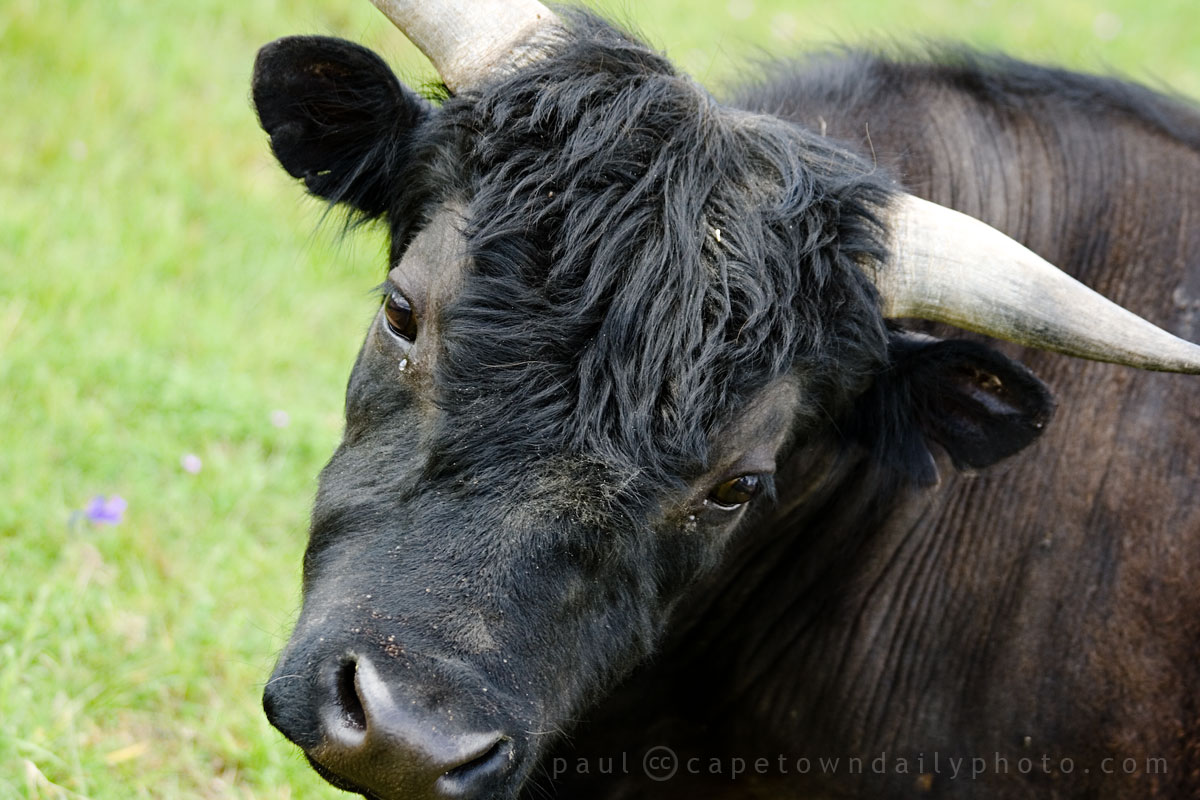
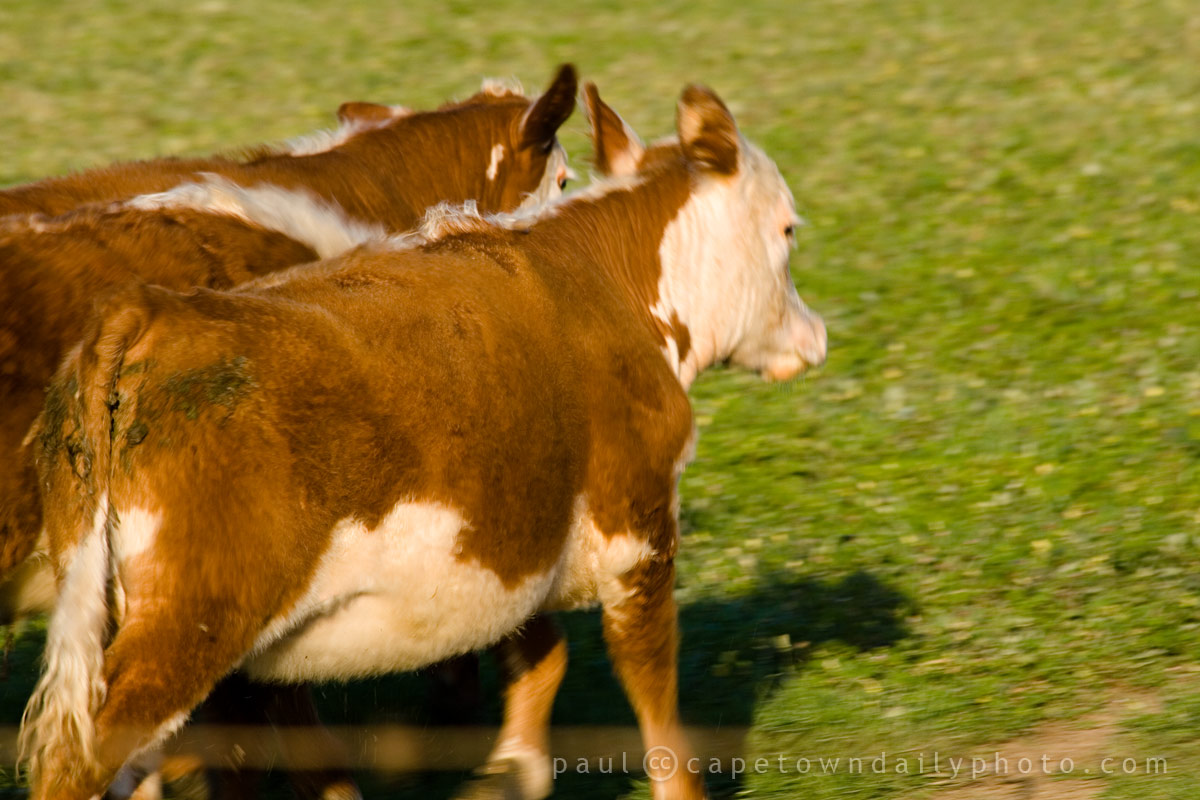
I like cows, though, it seems perhaps they're not as fond of me. Or, perhaps the weapon that I was pointing at them (aka camera) was too terrifying for them to bear. The moment I stood near the lead scaredy cow bolted, taking the others with her.
Today we buy our milk from Woolworths, Kwikspar or Pick 'n Pay. In years gone by my mom gathered us three kids up for a weekly trip to the milk farm up the road - to buy fresh milk in 5-litre buckets. The best thing about buying the milk from the farm was that the cream would rise to the top of the milk (remember those days?) and us kids were allowed to scoop it off to pour over our cereal!
Is there anybody out there who still gets their milk directly from a farm?
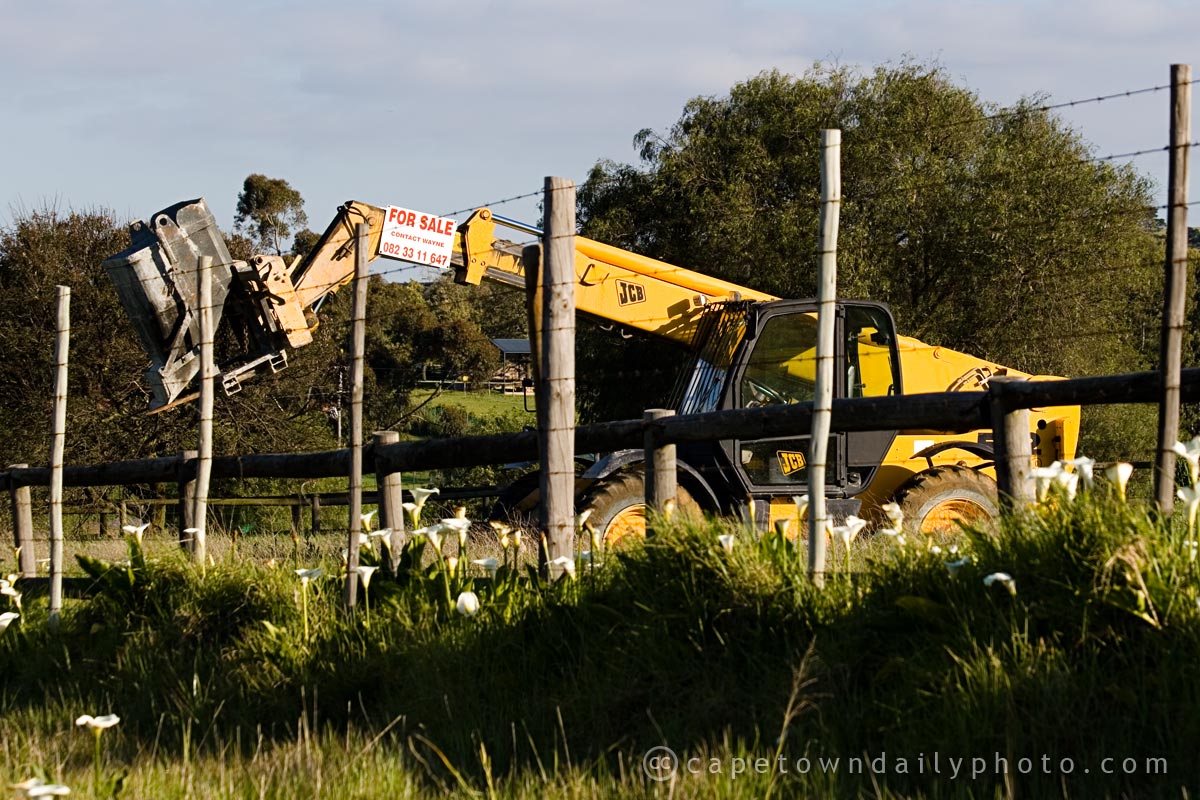
Boys love toys - really we do. Give any guy the chance to play with one of these and I guarantee you that they'd jump at it. Imagine using a few of these for team-building exercises! Speaking from a guy's perspective, it would be fantastically awesome to have a couple of hours to drive one of these puppies around, being able to just dig up huge amounts of soil.
Okay, to be fair, perhaps one would have to go for a lesson or two - but, given enough space, I'm sure that they're not that difficult to work out!
I'm interested to know how many of our female readers would like to play digger-loader digger-loader. Guys, feel free to answer too, but I'm fairly sure that for the most part I know the answer. Ladies, how would you like to spend a few hours fiddling with one of these toys?
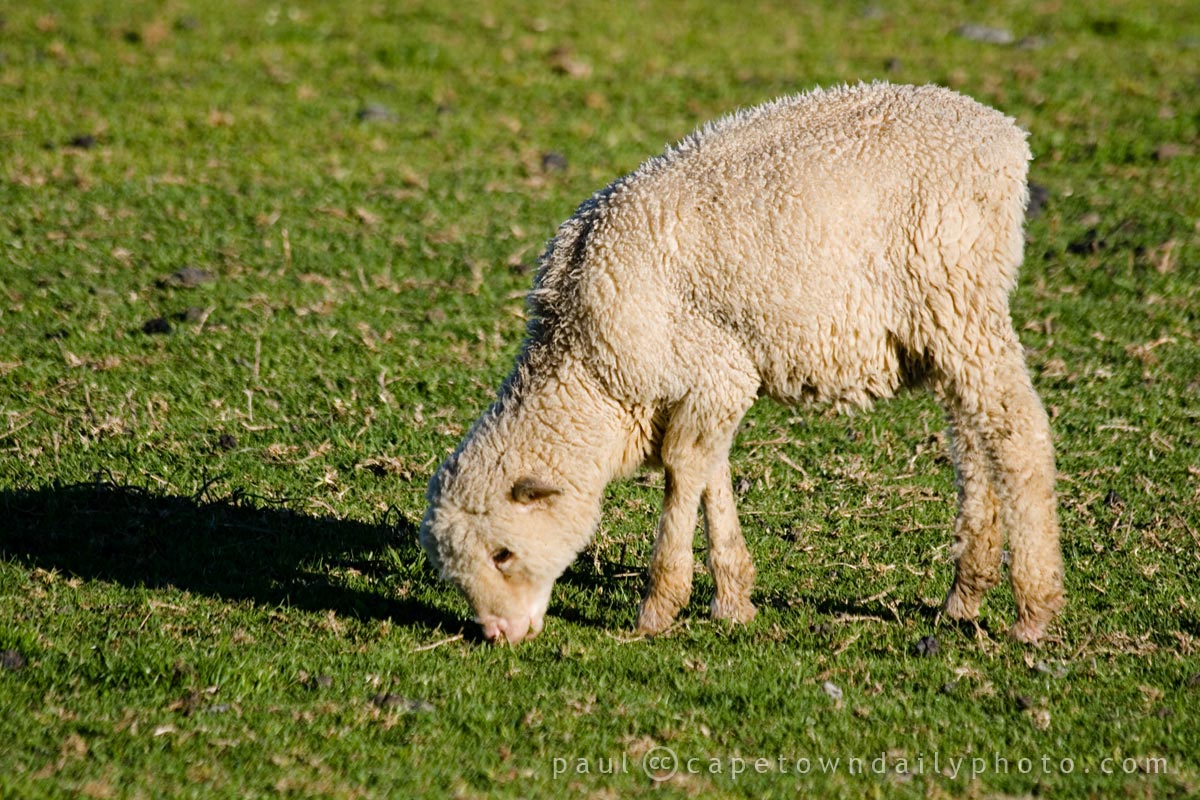
Kerry-Anne loves lambs. What more is there to say, really?
When on honeymoon a few *cough* years ago we stayed over at a remote self-catering place called Red Stone Hills. It's out on a farm and really (REALLY) rustic. We took a walk around the farm one day and Kerry-Anne decided to get into the pen with the sheep... who promptly surrounded her. Not so cute anymore were those killer sheep! It was amusing to watch her raise her hands in the air and squeal for help. Boys are so mean - apparently. :D
I love these kinds of roads; the trees form a tunnel that makes me feel like a Formula 1 driver - only without the Formula and without the 1. Not that I'd actually be able to drive at those speeds on our roads as, irrespective of the actual day of the week, there's invariably a Sunday-afternoon-cruiser enjoying the drive somewhere ahead of me. At times like these I need to remind myself that it's okay, perhaps even good, to drive s-l-oooooo-w-l-y. :)
Congestion on Cape Town's roads has been increasing steadily over the past years, with the effects being felt more intensely since the 2010 Soccer World Cup construction work began. Large alterations are in progress at the N1/M5 interchange near the city, as well as at Hospital Bend, which look as though they'll improve the rush-hour traffic problems significantly.
Believe me, most of Cape Town can't wait for them to be done!
Take a look at this 2008 article detailing the intended upgrades.
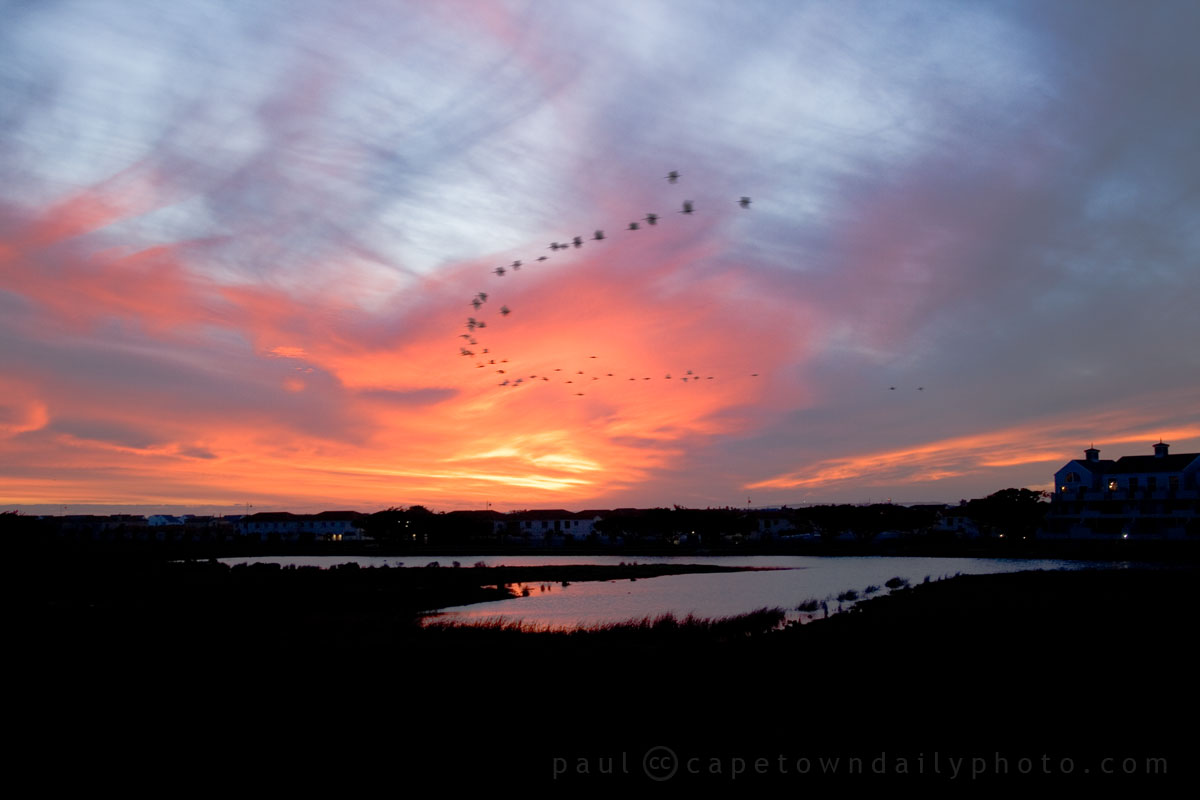
I found this photo in our archives - Paul took it about three weeks ago, but I decided that it's too beautiful not to post. It looks almost like something that Monet could have painted - can you see the brush strokes criss-crossing the sky? He probably would've added a bit more yellow, mind you. ;-)
Friends of ours get to look out at this scene every evening, from the balcony of their flat in Milnerton. I think in future we'll have to time all our visits to coincide with the setting sun - there's something so serene and calming about watching birds taking flight as the sky is changing colour. For a few minutes you're forced to stop talking, stop thinking, stop working, and just absorb.
This photo reminded me of the Birds on the Wires musical experiment - if you haven't listened to it yet, stop whatever you're doing and listen to it now. Go on, you need the break. ;-)
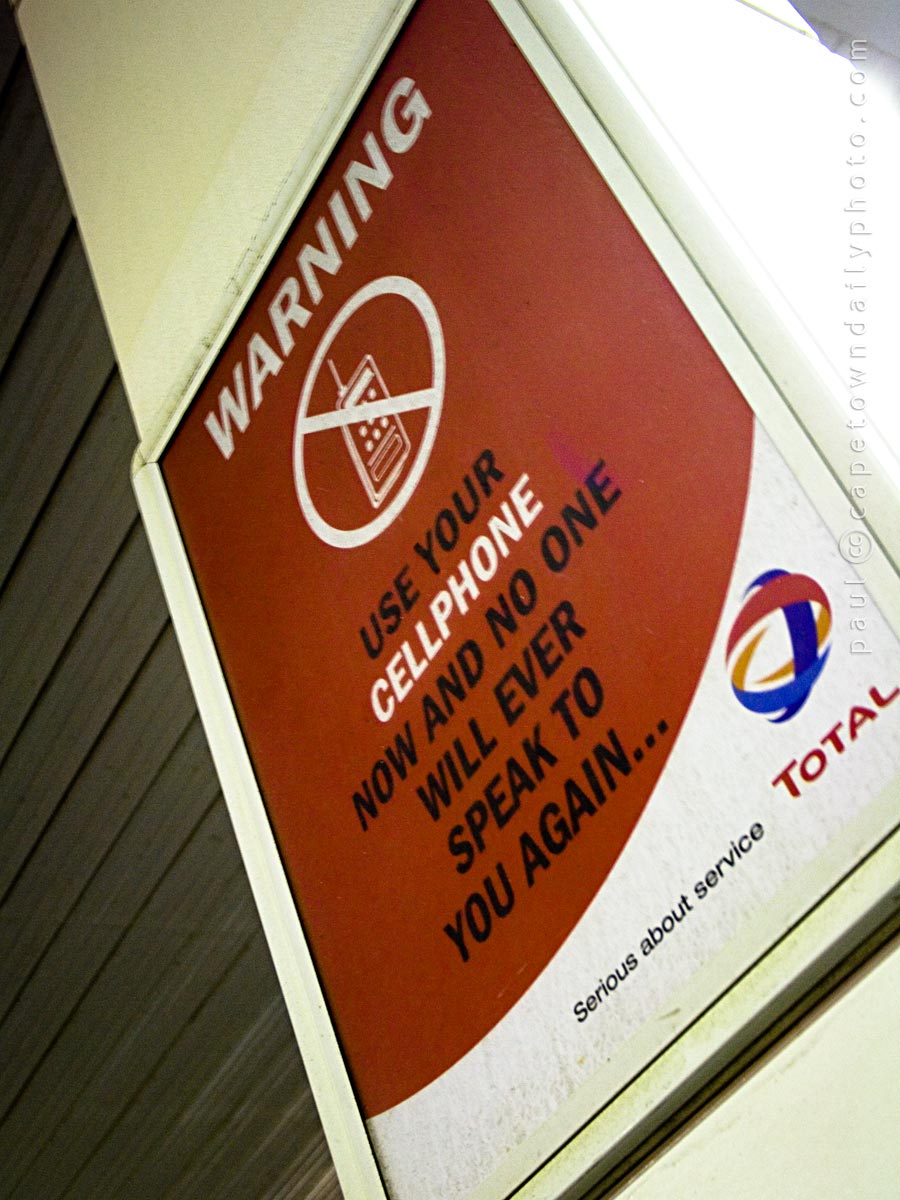
Whoa guys, isn't there a slightly more subtle way of getting the message across? How about "your phone could possibly, perhaps, maybe cause the fumes to ignite and you may, might, could get terribly injured"? :)
Aside from the text and its bluntness, the thing that I found amusing about the photo was the "Serious about service" tagline at the bottom of the sign. Not that I'm suggesting that Total's not serious about service - they're as good as the next filling station; but the contrast in tone is pretty funny, don't you think?
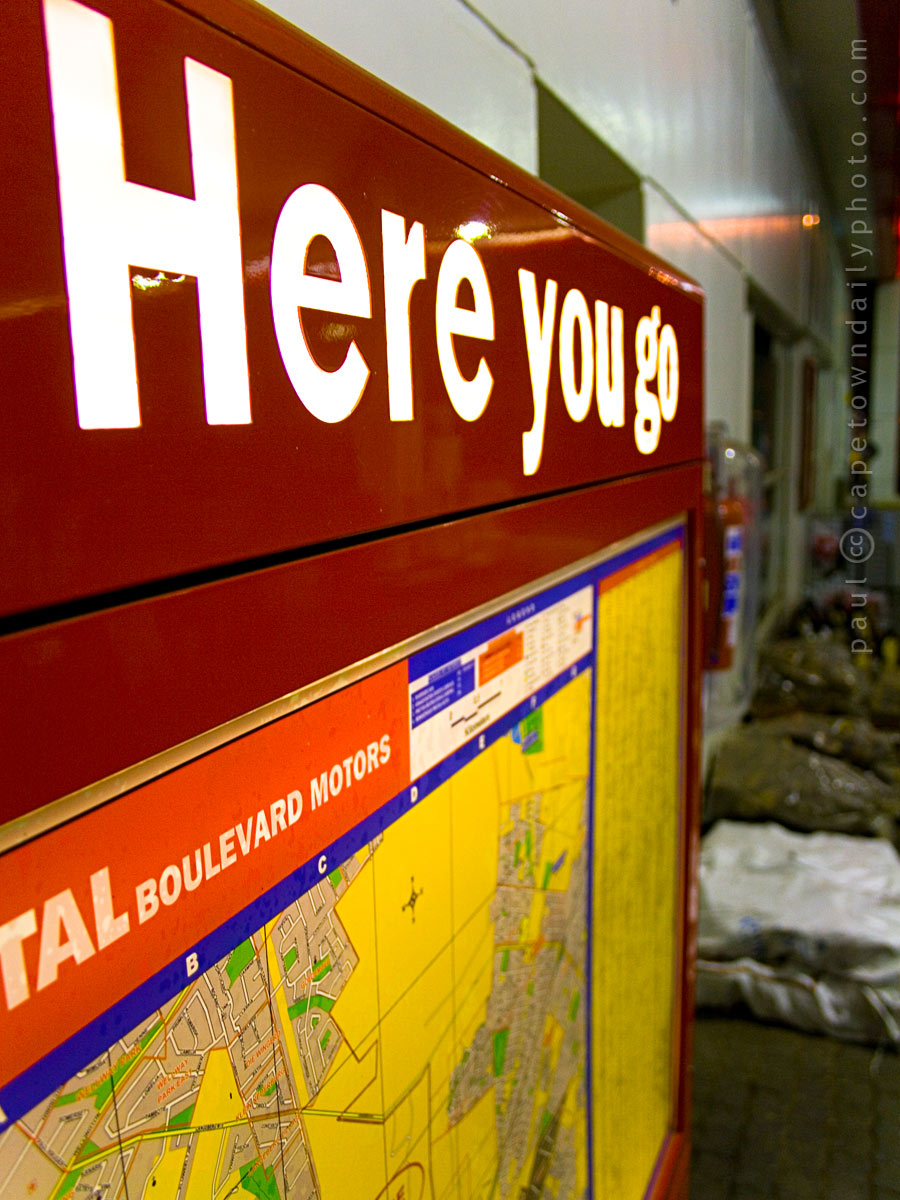
If you don't have a GPS and don't know your way, remember that our fabulous fuel filling stations often have large maps for you to peruse. And, even if the one that you spot doesn't, the friendly staff are bound to be able to point you in the right direction.
When hiring a car in South Africa, remember that at an additional cost you can have a GPS unit included in the deal. It really is a good idea to use one if you don't know the area. One thing to remember, however, is to never let the GPS take over the functioning of your brain. Don't just follow where it thinks you should go. Unless someone's been kind enough to program the device for you, a GPS isn't able to differentiate between the good and bad parts of town.
It's always best to plan your route first and rely on the GPS second. Happy exploring!
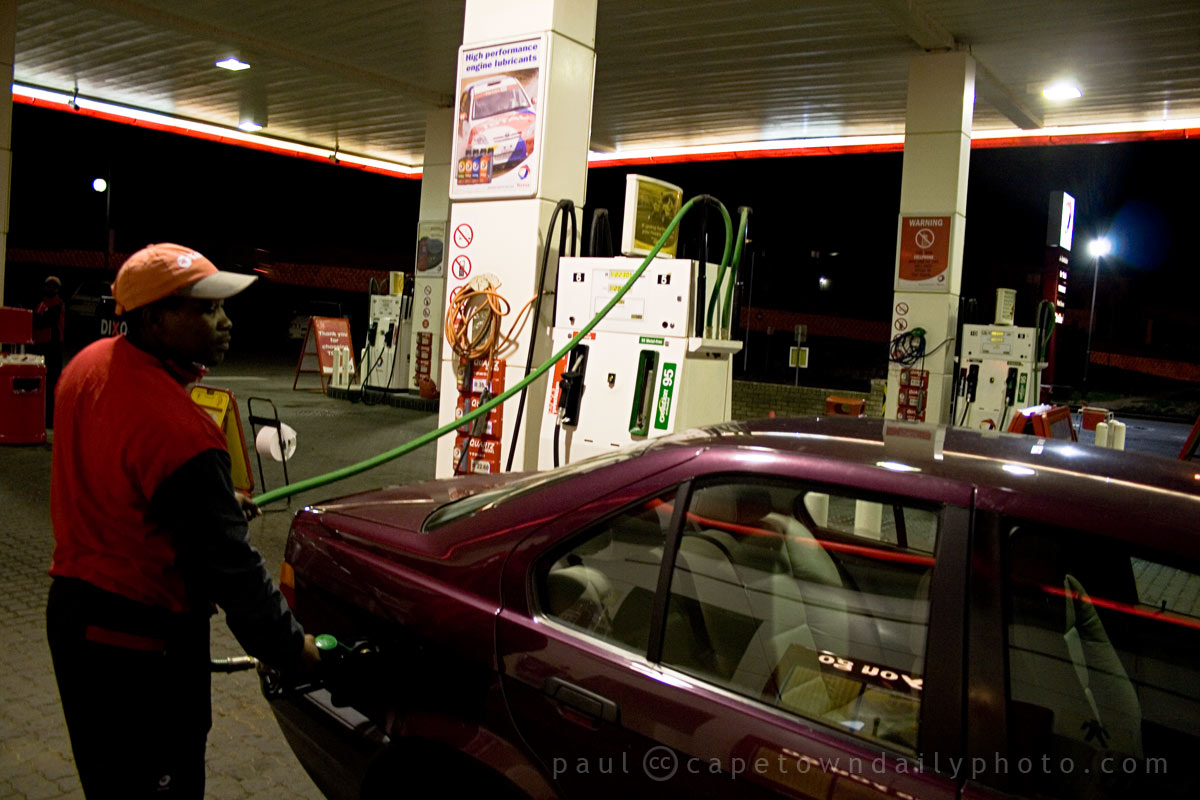
I understand that in many places around the world motorists fill up their own vehicles with fuel. Lazy South Africa still enjoys the privilege of having a friendly attendant to fill up your car, wash your window, pump your tires, and top up your oil. Well, I say friendly, but I have to admit that they're not always friendly. Considering that the job isn't a stimulating or enjoyable one, I guess that's understandable.
If you visit South Africa from another country then you should bear three things in mind when filling up your hired vehicle:
You'll have three types of fuel to choose from: Unleaded, Lead Replacement (LR), and Diesel. Normally hire cars use unleaded, but if you're not sure it's normally indicated somewhere near the filler cap. Mixing diesel and petrol is a bad idea. Seriously. :)
In July this year a law was passed allowing motorists to purchase petrol using an ordinary credit card (previously we could only use garage cards, debit cards or cash). However, not all petrol stations have implemented this system yet, so you may very well still need cash to pay for your petrol. Often filling stations have ATM machines where you can draw cash with your debit or credit card.
We usually tip the attendants. You don't have to, but if they are pleasant - and especially if they wash your windscreen - it's a nice thing to do.
I'm interested to know whether you tip filling station attendants, and if so, how much. Please leave a comment, anonymous or not, and let us know.
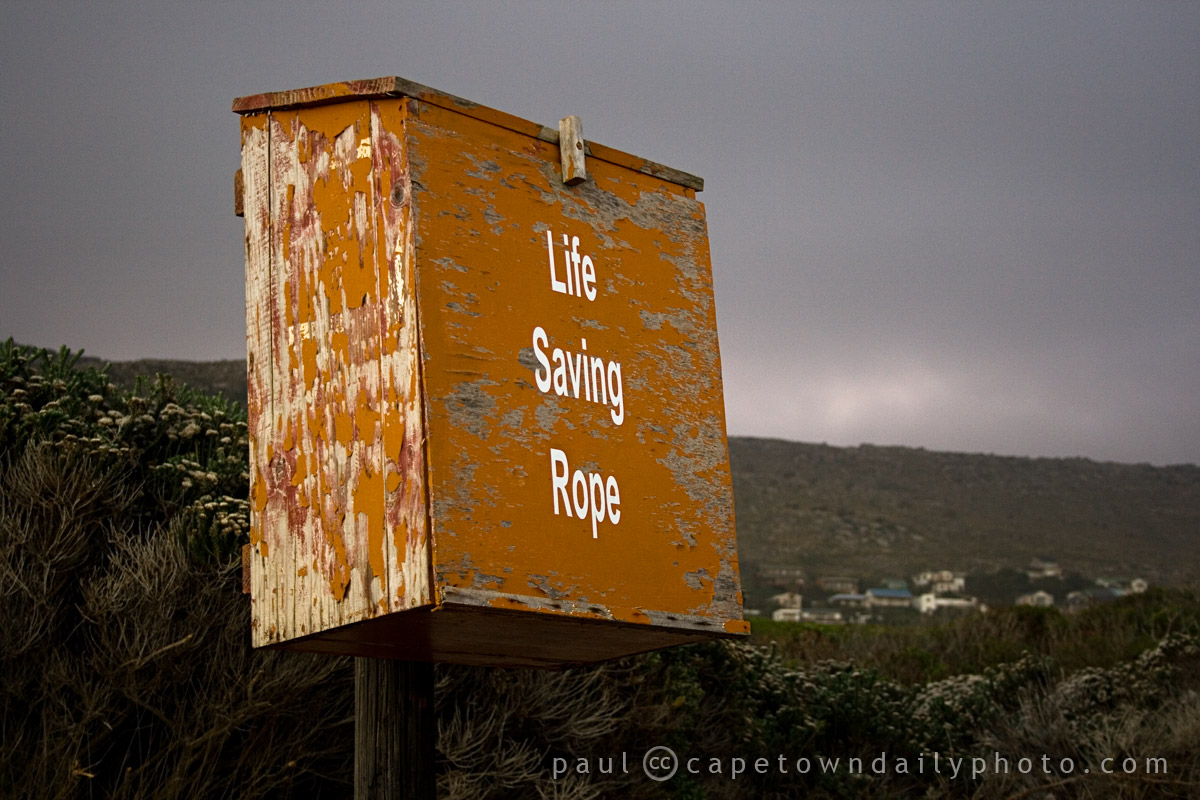
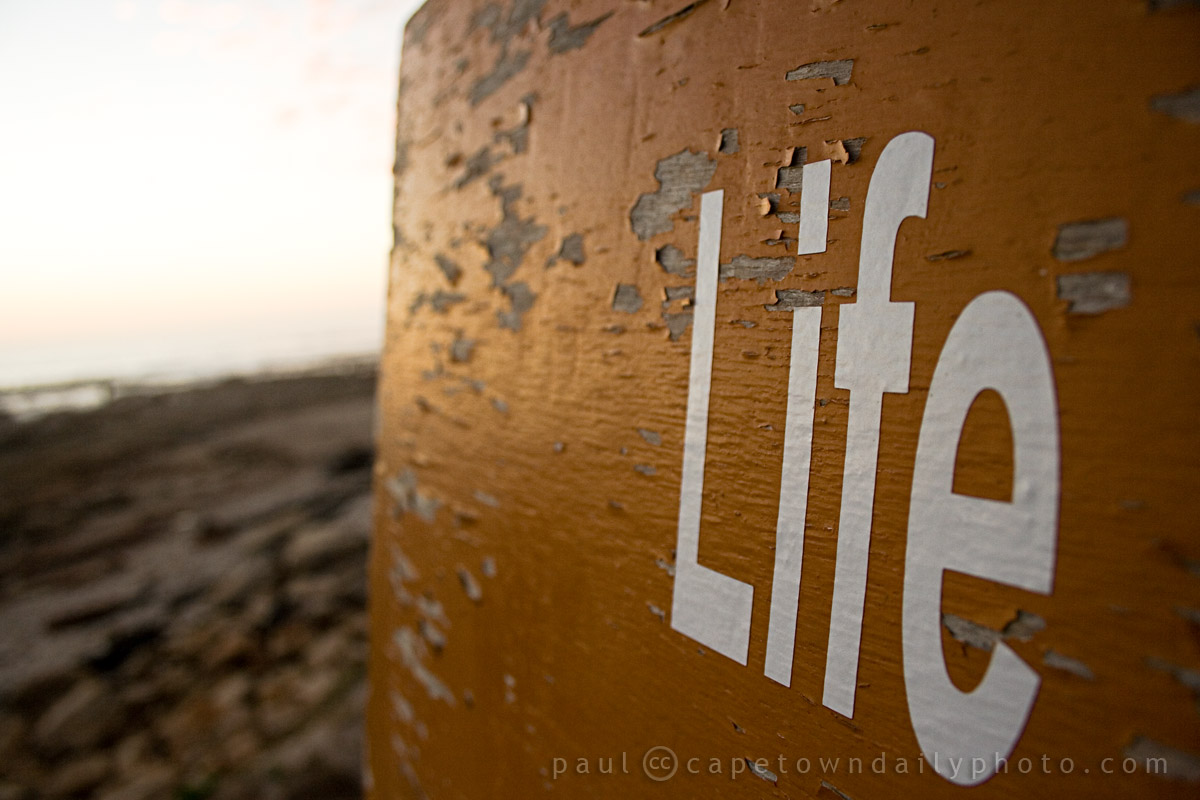
If you saw yesterday's post and thought the photo was of some kind of life saving apparatus, you would have been right!
Deems left a comment yesterday expressing surprise at the newness of the lettering versus the old peeling paint. I think this version of the photo emphasises that even more. The nice, new, neat lettering contrasts with the peeling paint and the stormy skies.
And if you were to open the box (as I did :)), you would notice yet another contrasting element, in the form of the brand new rope that lies coiled inside.
When I was younger there used to be a competition running on television that showed a close-up photo of an object. It was often something obscure like the eye of a fly, or a thimble, or some other "everyday" object. It was invariably very difficult to guess exactly what the object was because without the full picture or proper context the object could be one of many different things.
I don't think it's quite as difficult to tell what this photo is of, but then again, I've already seen the entire picture. If you have an idea what this photo may be of - please take a guess and leave a comment below. :)
It seems as though the ship, a coal carrier, that ran aground on Blouberg Beach in Table Bay will be around for a little while still. News reports are still a little sketchy, but it looks like they're considering pumping the vast amounts of fuel off the ship.
For the full story, and the reason why we're so proud of the National Sea Rescue Institute, read their report of what happened, on the NSRI website.
What you're seeing in the photo are bajillions of crushed seashells on the seashore. I do hope that the ship doesn't start breaking up into a bajillion small pieces on Blouberg Beach!
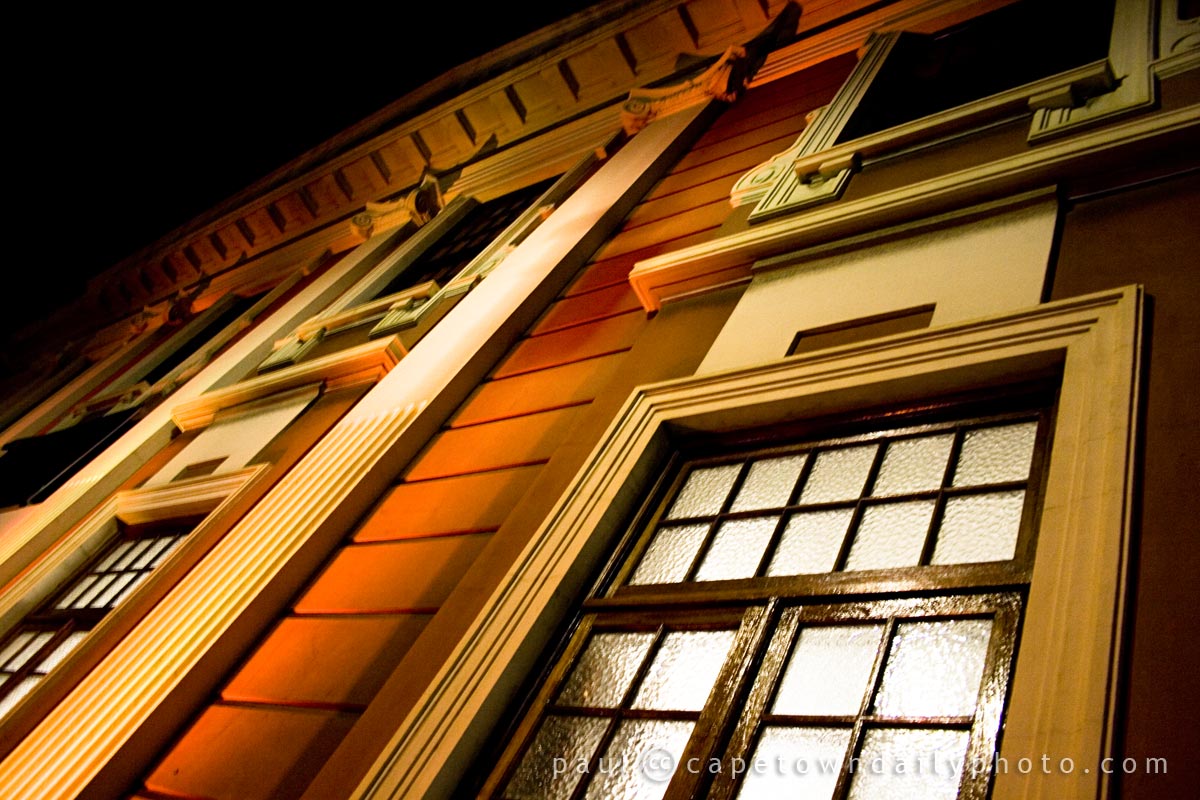
Aren't old buildings just awesome? They tend to have such great lines for vertical close-up photos. I sometimes wonder whether or not in 30 or 40 years we'll have similar thoughts about today's modern structures. Fortunately for us, Cape Town has many buildings just like this one, and it seems that they'll still be around for quite some time. As long as they're still in perfectly good condition there's really no way to justify ripping them down to erect newfangled ones. :)
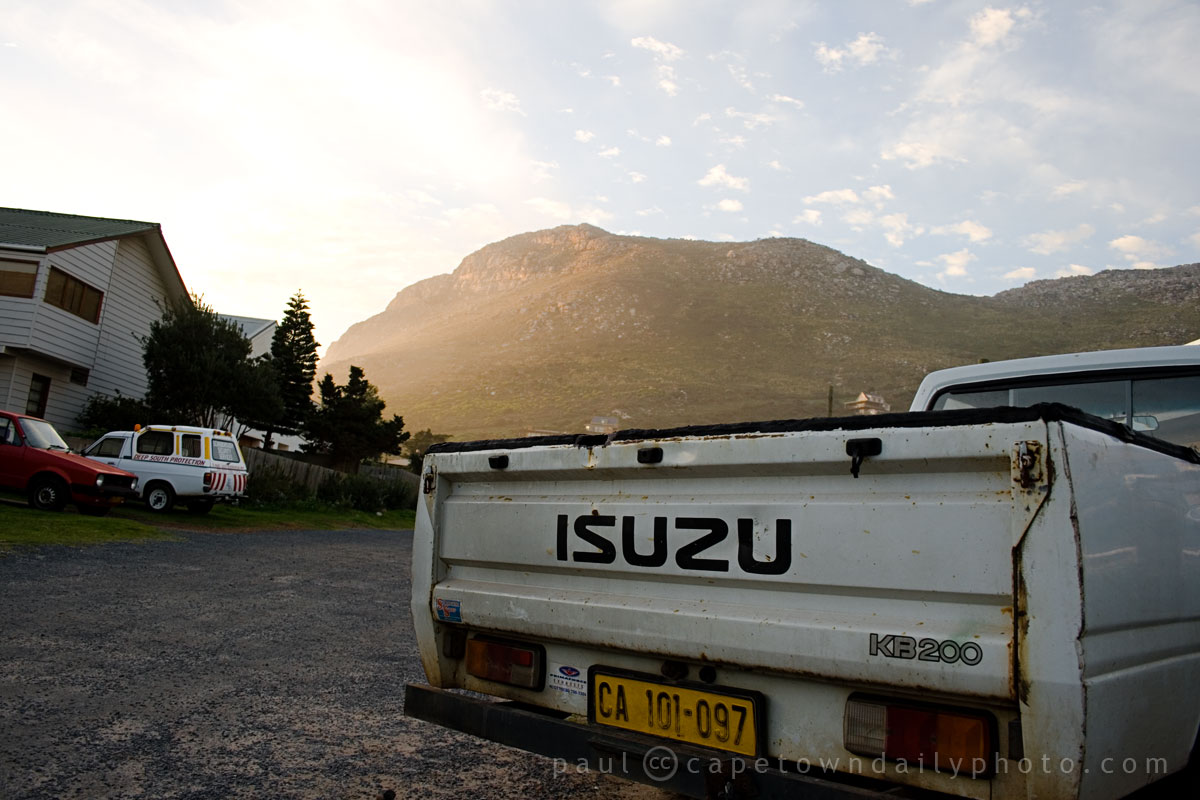
I'm sure that many of you will recognise, and perhaps love or hate, the make of bakkie (an Afrikaans word pronounced "buck-key") in this photo. For some reason South Africans love their bakkies. Heck, I've often been tempted to buy one just because they're so convenient when something that won't fit into a regular car boot needs to be carted around.
But at the same time, I also hate bakkies. Since many of those that frequent our roads have older diesel motors, they don't accelerate particularly fast - especially when overloaded, as they often seem to be. Also, older models generally puff huge quantities of smelly diesel fumes that force me to roll up my windows and block my car's air-vents.
It's true though - these smelly, slow machines are work-horses and play a huge role in keeping our economy going... so perhaps I should tolerate them a little more than I tend to. That said, it would be great if more owners could afford to have their vehicles fixed up so that they puff with a little less vigour.
Oh, the answer to the question posed in the post title is that both blow huge puffs of grey or black smoke. :P
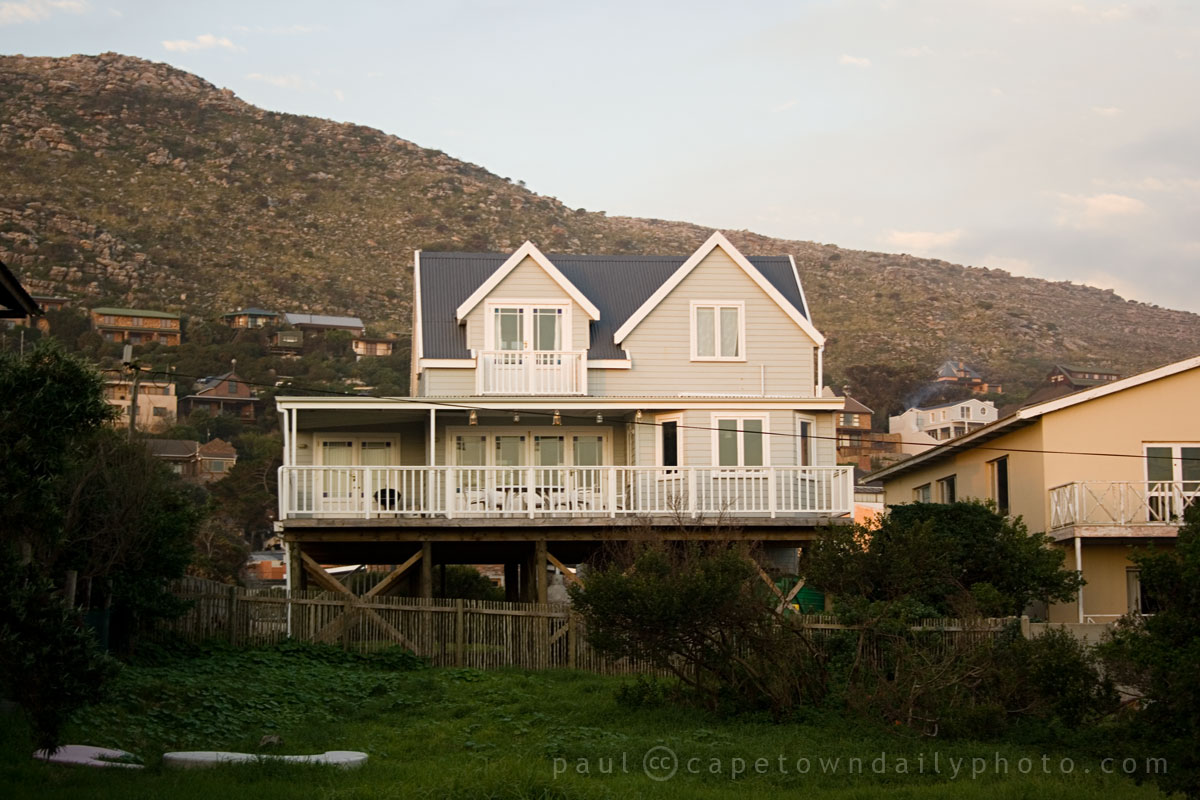
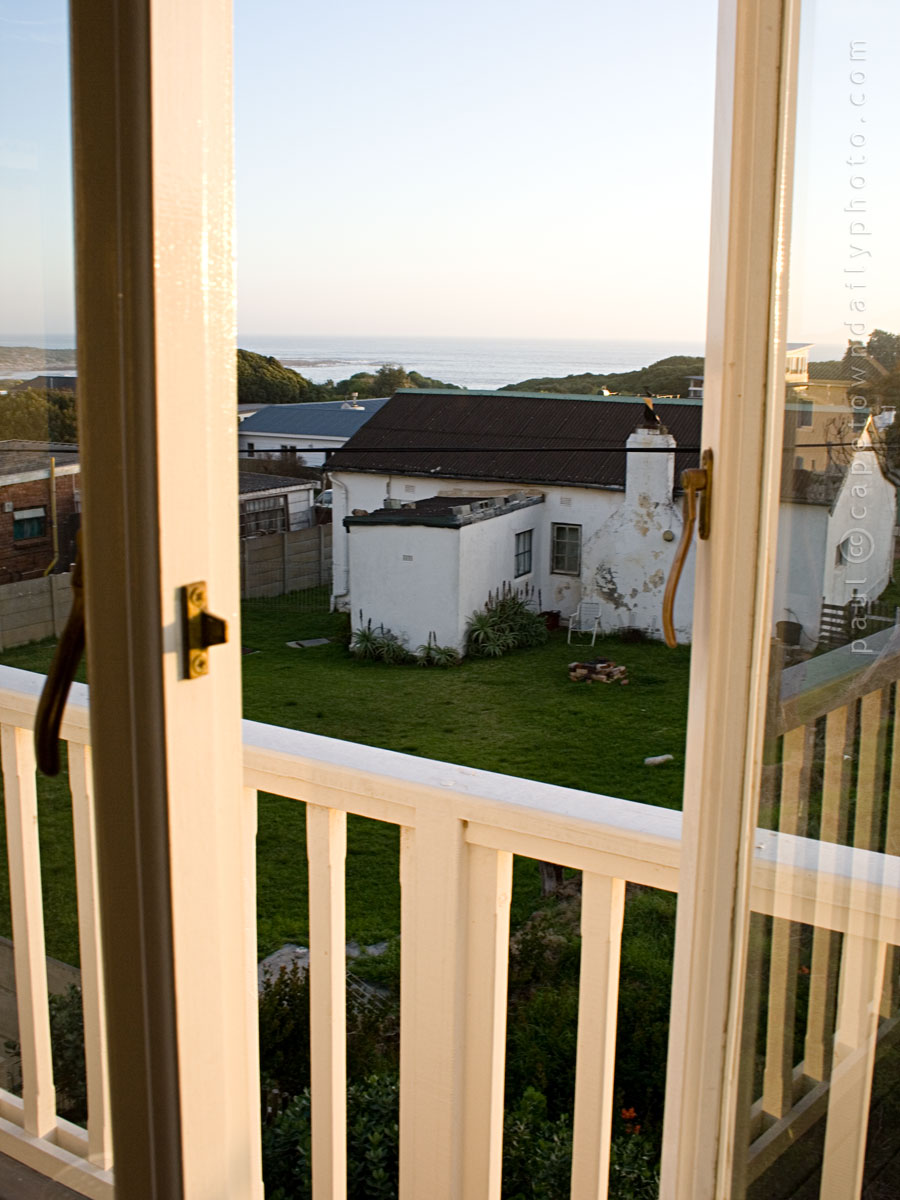
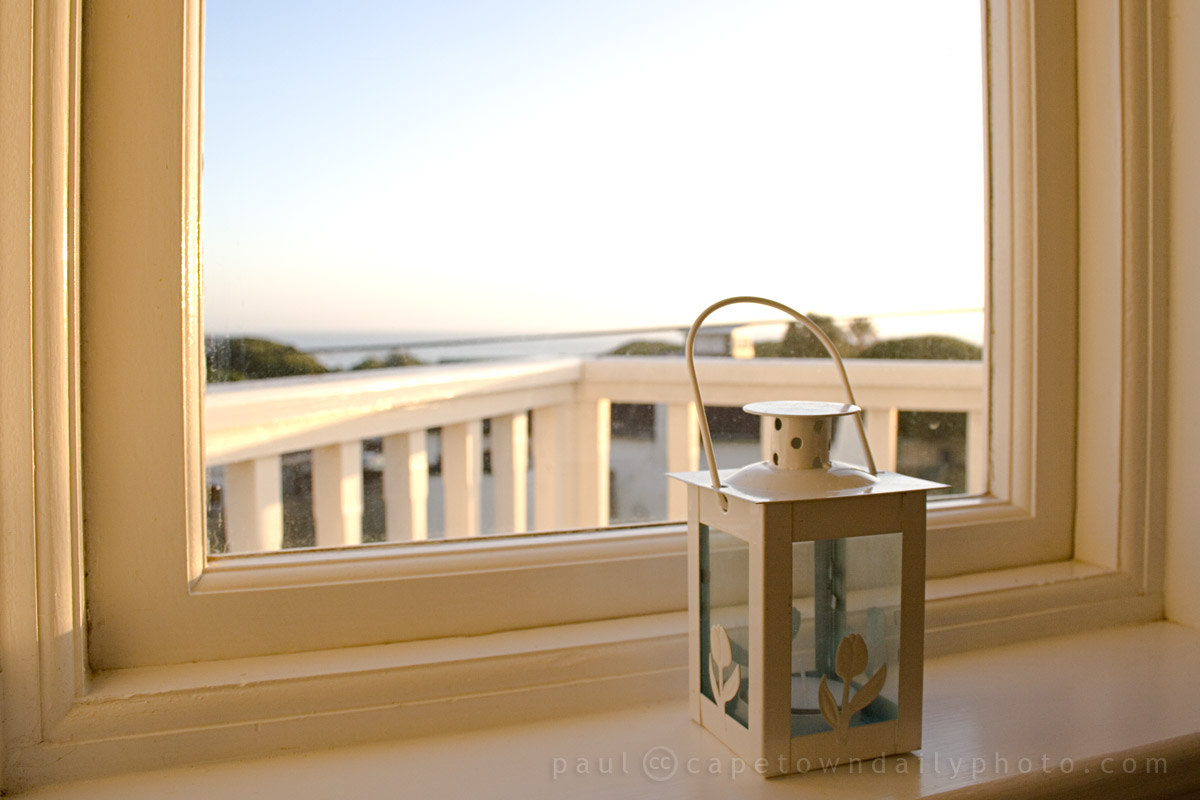
The first photo in this series was taken from the upstairs window on the right, and the second photo was taken from the doors on the left. I found myself wishing that I could pick the entire house up, put it on the back of a (very large) truck, and transport it to our suburb. I quickly realised, of course, that a huge part of the charm of this house lies in its environment - particularly the ocean views you caught a glimpse of in the previous two posts.
And tomorrow you'll get to see exactly where all these pretty photos were taken - if you haven't already guessed. ;-)
Here's another visual clue to the location of our friend's house, mentioned in our previous post. Isn't this view just divine? Even though it's quite a distance to travel from here through to the city centre for meetings or social events, I can just imagine that coming home to this heavenly picture makes all that driving seem somewhat insignificant.
And then, of course, there's always the possibility of spotting a whale frolicking in the surf...
This weekend we visited a friend of ours who lives on the other side of the planet. At least it seemed that way, given the distance we had to drive to reach her house.
I have to say, the trip was entirely worth it though, for this is the view that greeted us when we arrived. The small seaside village that our friend calls home has plenty of holiday houses, and isn't too far away from Cape Point.
You'll win a great deal of respect if you can guess the name of the village from just this description and the photo above. Have a try - where does she live?
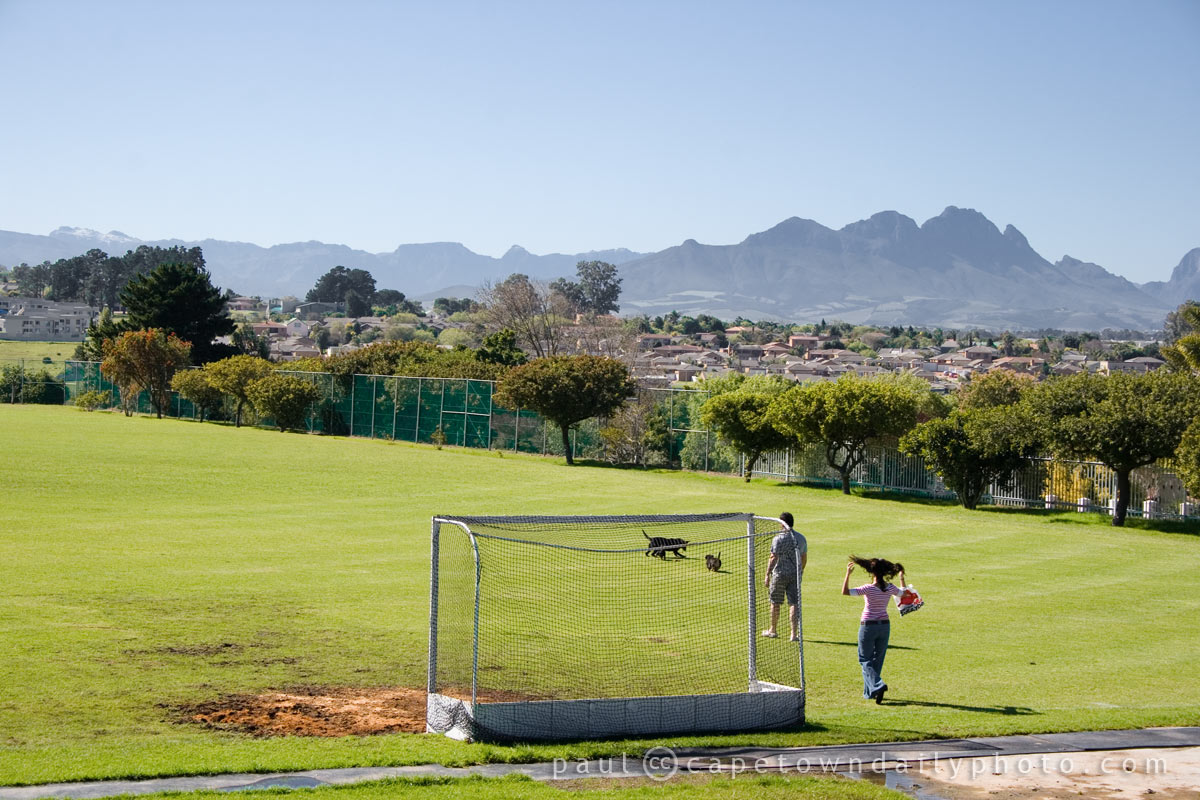
A couple of months ago I mentioned that I used to have a great view of the R300 fly-overs from my high-school classroom window. Well, here's another rather pretty view from my old school, Stellenberg High.
I can't say that I spent much time on the field in the picture, except for when some sort of non-sporting special event was being held there - I was not particularly strong in the hand-eye co-ordination department, so sport was not my thing. I do remember spending many a spring afternoon playing "social tennis" on the tennis courts from which this photo was taken, though. (I played "social netball" for a while as well, and even "social squash" - basically, that's what they called it when you weren't good enough to be on an actual team.)
To be honest, I think my friends and I got more exercise from laughing at one another's incompetence with the racquet than from actually hitting the ball. Good times. :)
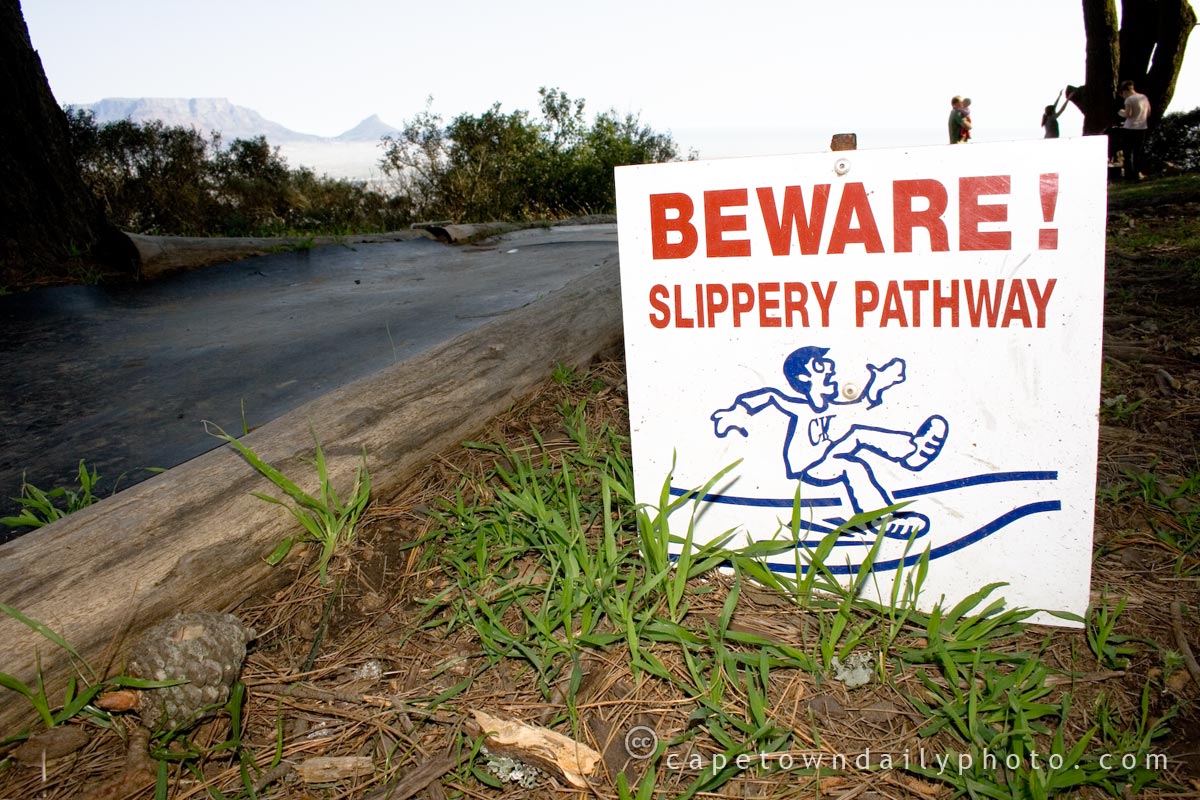
How many times have you tripped on a step because you didn't notice the "Mind Your Step" sign? And how many times was that due to the fact that the "Mind Your Step" sign was posted on the step itself, instead of at eye level, where you were most likely to be looking?
Similarly, I wonder how many people notice this sign for the first time when they're inches from the ground, with their feet in mid-air and their arms flailing at their sides. "Oh! It's a slippery pathway! That's why I'm falling!"
The Metro Emergency Medical Services is a government organisation with about 1400 staff, that provides emergency response to the public.
The reality of the situation, as I understand it, is that the Metro EMS ambulance services are over-extended and unable to respond quickly enough to many time-critical medical emergencies and so, even though my dad's medical aid generally only covers the use of state ambulances, his house doctor requested a private ambulance to transfer him to the hospital. Sadly, some people have no option but to rely on state ambulances, and while they do successfully assist many, in times of crisis they're sometimes simply not able to respond in time.
Apart from being short-staffed, all ambulances continuously have to deal with other drivers (unbelievably) doggedly standing their ground, refusing to let ambulances pass in any kind of hurry. I often see drivers not paying attention to emergency sirens, and I've honestly seen drivers on occasion just not make an effort to open a path for ambulances. Unbelievable? Believe it.
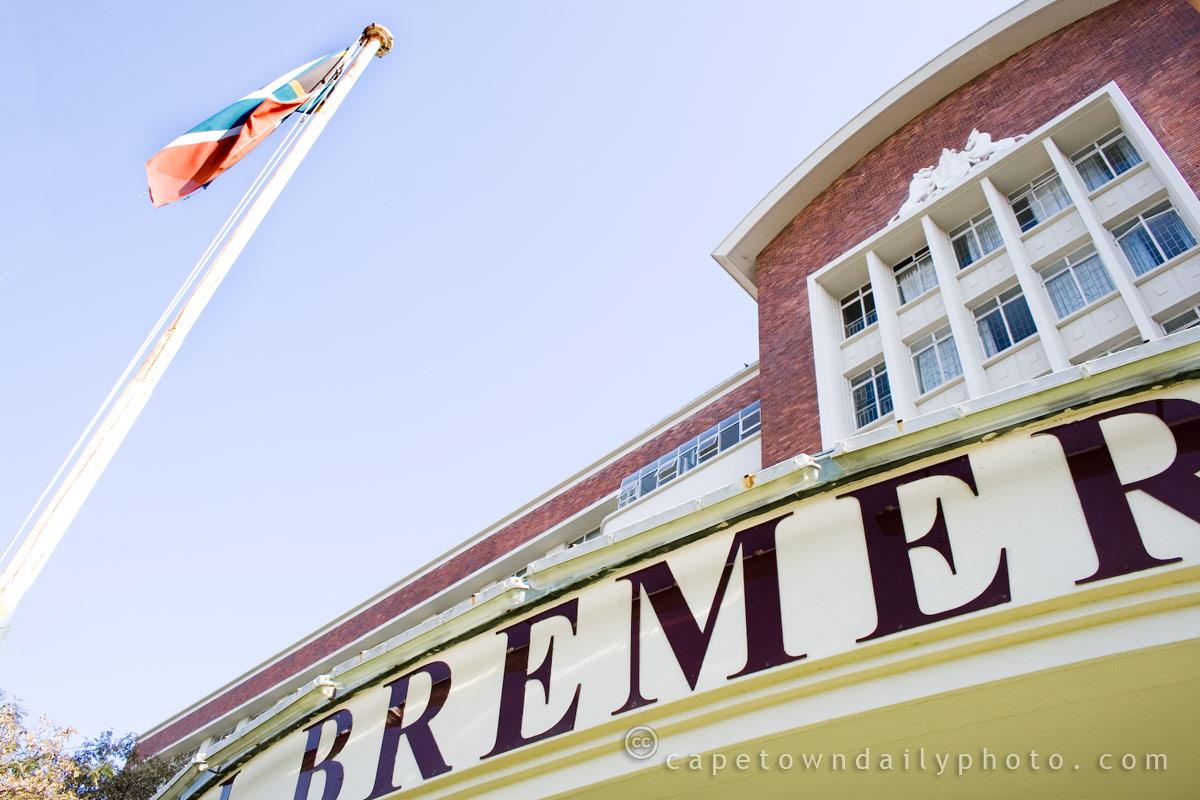
A few people who commented on the photo posted yesterday were correct in guessing that the shot was taken in a hospital - a government hospital, Karl Bremer, to be exact. As I walked the corridors on Friday afternoon, I recalled that the last time I'd been in the hospital was when my sister was born, about 30 years ago. I was very young at the time, but I remember sitting in the waiting room while my dad visited my mom, who'd just given birth.
There was less excitement associated with this visit though. My 70-year-old dad suffered a heart attack at about 12h00 while he was doing some hard labour trying to find an underground water leak at his home. My mom took him through to the doctor, who immediately called an ambulance, realising that my dad's condition was life-threatening. Upon arrival at the hospital his heart in fact stopped, but fortunately the doctor attending to him in the trauma unit managed to massage his heart back to life. The next few hours were tense as we waited for the drugs to take effect; and by the grace of God he managed to pull through.
In closing, I thought I'd provide a point-form commentary on my experience of Karl Bremer Hospital:
- Admission to the trauma unit (from the ambulance) is fast.
- The process to follow at reception is confusing and slow.
- The trauma doctor on duty was knowledgeable, courteous, and professional.
- The sisters in the trauma unit were firm, yet lenient enough, and professional.
- The sisters in the ICU were well-organised and paid close attention to their patients.
- The building was neat, but old and in need of renewal.
- The security staff were friendly and helpful.
You may have noticed that we've been struggling to keep up to date with our daily photos. Plenty has been happening on our side to keep us busy and otherwise occupied. Sometimes I wish that I'd known the consequence of calling this website Cape Town Daily Photo. :) At other times, I'm really glad that this site has a photo for each day of our lives. It's awesome being able to page back through your life a day at a time. To date we have about the last two-and-a-half years represented, with a single photo for each day. It's really awesome; you should try it!
Okay, so I'm now catching up, and this photo leads into my post for tomorrow. So pray do tell, if you're able to guess, where do you suppose this photo was taken? A school hallway? A prison?
As you by now know (perhaps due to the title of this article), the Protea is South Africa's national flower. It's perhaps easy to imagine why it's the case, (a) they are fantastically beautiful, and (b) there are huge numbers of them in many different species all over South Africa. Just take a look at the map on this page and click on the Western Cape. Click on the various coloured blocks representing areas and the species found there. Hectic hey!?
A couple of interesting points about the Protea are:
The largest flowers grow up to 300mm in diameter!
Once planted, don't ever think about moving the plant, or disturbing its roots. I now have 3 dead Proteas in my garden. :-(
Most Protea species protect their seeds from rodents by using ants to carry seeds underground or by protecting them in cones that release the seed only during a bush fire. Some Proteas in fact encourage rodents to carry off their seed by dropping juicy fruit on the ground. They produce abundant seed for a short period, causing rodents to hoard the seed in nice damp places, often covered by a little soil. Rodents often end up not returning for the food, or simply not being able to find all of it! This naturally encourages germination, and voila, a new Protea bush erupts.
In yesterday's photo I drew attention to one of many pieces of litter littered about in a nearby field. Today our photo focuses on a different, and possibly more damaging, form of environmental damage. Yes, you have it, fossil fuels. This fuel tanker was headed for the Caltex oil refinery in Milnerton where it was presumably to pick up a consignment of diesel or petrol.
What I've always found strange is that for years we've all heard about hydrogen-powered cars and cars powered by water, but it seems as though petrol- and diesel-power still flourishes. For years the world has voiced concern over the environmental impact of fossil fuels, but clean-energy vehicles never seem to take hold. Even vehicles like the Toyota Prius aren't great for the environment... well, at least not the first few iterations (read more here).
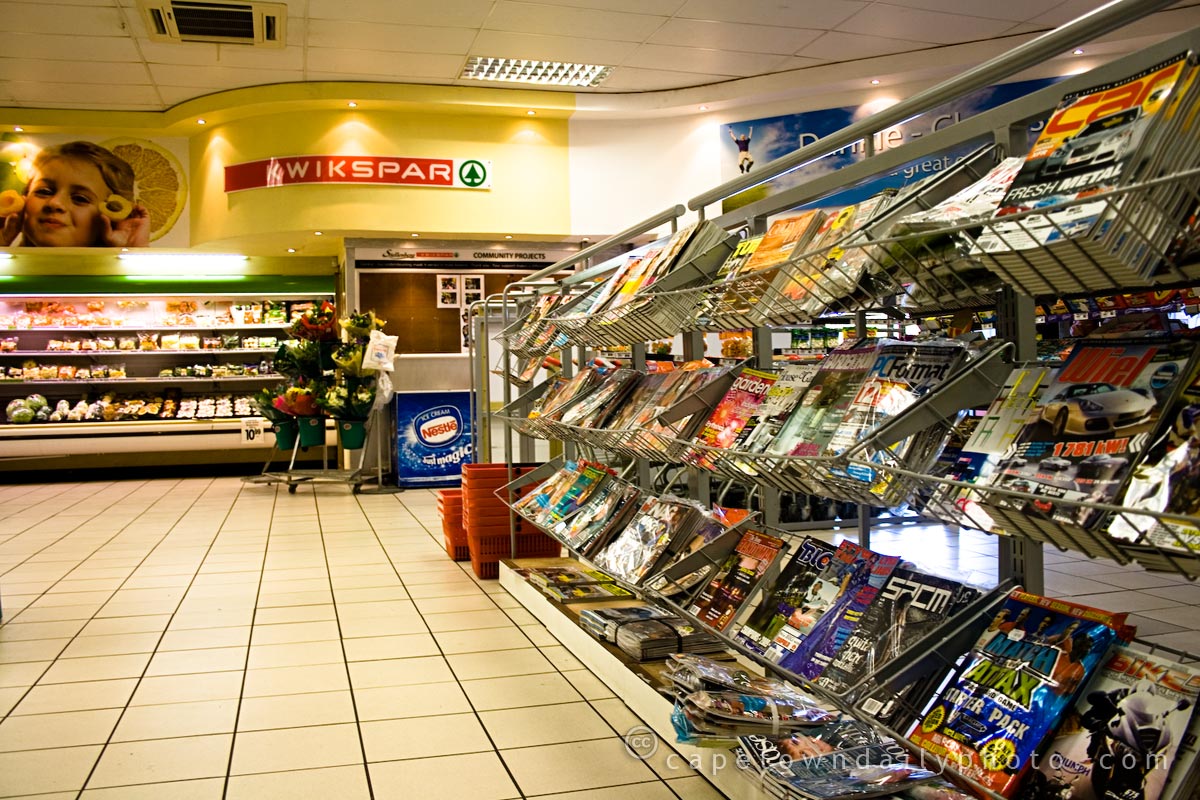
Instructed to find fresh bread, rolls and a pack of very lean bacon, I hurried over to our local Kwikspar, which is only a short walk from our house and (for the record) is one of the best Kwikspars that I've ever shopped at. The staff are normally pretty friendly, and the managers are even more so. The shop is always clean and tidy. The veggies look pretty fresh. The meat is of pretty good quality. There's always a variety of fresh bread and rolls.
I've found myself buying more bread from the Kwikspar's bakery lately. For the last few years we've been buying a brand of "toaster bread" that's manufactured in bulk by large manufacturers. What started to concern us about this bread is how long it lasts... I mean, is it normal for bread to last 2 weeks and still be soft? When we thought about it we remembered that when we were kids bread bought on Monday was stale by Tuesday... and I think this is the way it ought to be, else there's something terribly wrong with the substance we call bread.
As I said, lately I've been buying fresh rolls and bread from the Kwikspar... and I can definitely say that it's way better than the artificial bread we were previously buying. I mean, what's better than a thick slice of warm bread with a chunk of butter? Yum!
Before anyone else settled in the Cape, the Khoi and the San (perhaps known more widely as the Bushmen) inhabited the area. Eventually, in 1652, the Dutch East India Company sent Jan van Riebeeck to establish a supply station at the Cape - and I guess this is where the battle for land and rule officially began (at least between Europeans and Africans).
Here's an interesting piece of information that I'm surprised I'd never considered before: before Table Mountain was named as such by the Portuguese admiral António de Saldanha it was known by the native inhabitants as Hoeri ‘kwaggo - or Sea Mountain. Given its location, I guess this makes absolute sense; though I guess at the time António must have misinterpreted his hosts' hand-signs and gesturing.