Even though our gardens are still enjoying rainy days, the smell of summer is already in the air. Well, at least in my nostrils it is. Spring has already arrived - trees and shrubs are sprouting leaves, flowers are blossoming and the air is slightly warmer than it was a month ago.
Summer in Cape Town is fantastic, with the only really bad part being that locals find themselves busy at work, many of them indoors, hidden away from the beauty of summer. The things that make it bearable for them (us :) ) are holidays, and the fact that summer days last until after the working day, with the sun setting after 8pm. Even when it's dark the warmth of the day lasts late into the night.
As you by now know (perhaps due to the title of this article), the Protea is South Africa's national flower. It's perhaps easy to imagine why it's the case, (a) they are fantastically beautiful, and (b) there are huge numbers of them in many different species all over South Africa. Just take a look at the map on this page and click on the Western Cape. Click on the various coloured blocks representing areas and the species found there. Hectic hey!?
A couple of interesting points about the Protea are:
The largest flowers grow up to 300mm in diameter!
Once planted, don't ever think about moving the plant, or disturbing its roots. I now have 3 dead Proteas in my garden. :-(
Most Protea species protect their seeds from rodents by using ants to carry seeds underground or by protecting them in cones that release the seed only during a bush fire. Some Proteas in fact encourage rodents to carry off their seed by dropping juicy fruit on the ground. They produce abundant seed for a short period, causing rodents to hoard the seed in nice damp places, often covered by a little soil. Rodents often end up not returning for the food, or simply not being able to find all of it! This naturally encourages germination, and voila, a new Protea bush erupts.
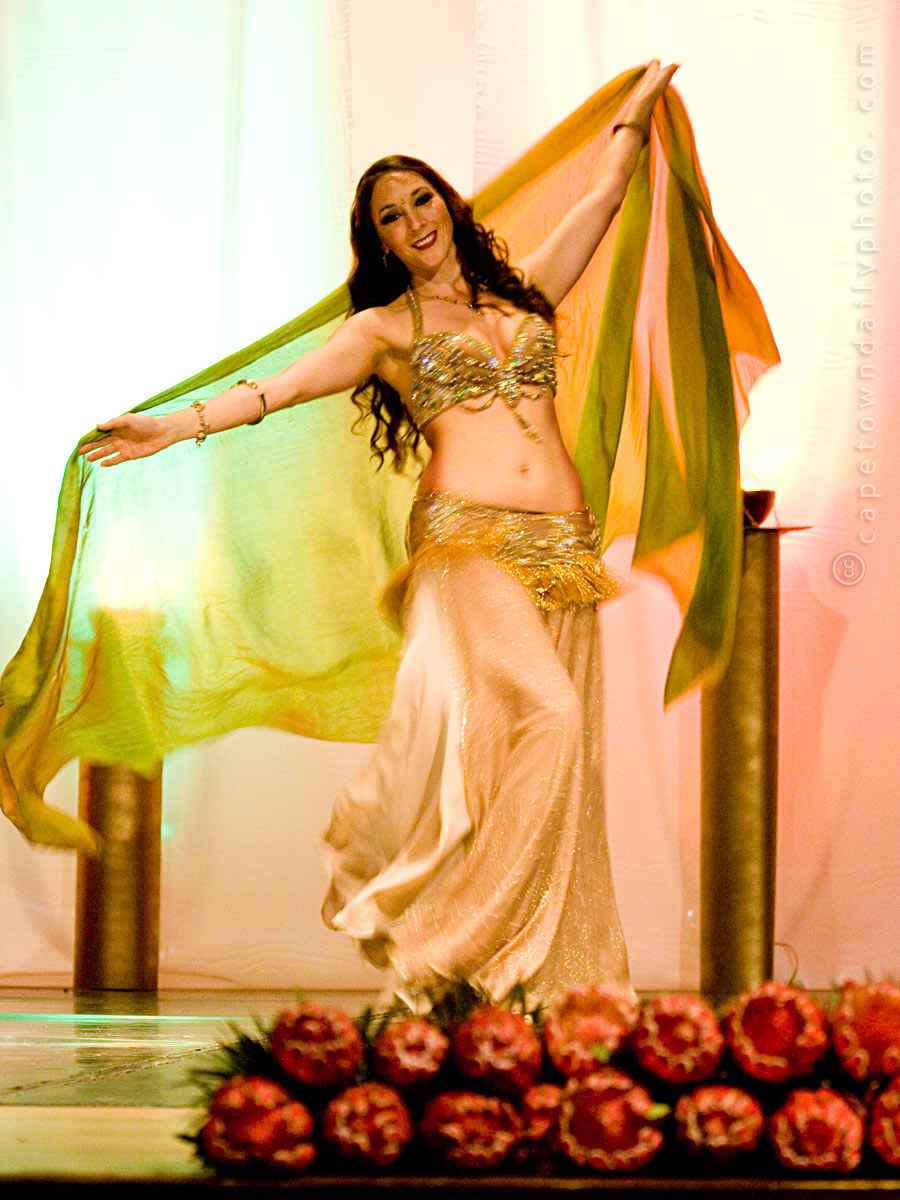
There's a cynical statement that says that people become teachers because they're not able to actually do whatever it is that they teach in practice. Tenille (in this photo) is the founder of and teacher at the Feminine Divine Oriental Dance Studio where Kerry-Anne attends classes, and I'm confident in saying that she both teaches and practises what she teaches like a pro.
Kerry-Anne's progress from her own unique... erm... style, to the performance delivered on Saturday (in only a couple of months) simply has to be proof of this! In fact, all round, the performances delivered by the (approximately) 200 dancing divas was worthy of a standing ovation.
I mentioned in my previoustwo posts that I've been working on photos from Saturday's show. Finally, I'm done. If you'd like to see the 200 best shots of the day, visit the photo album here... and please, don't forget to comment on photos that you think are simply awesome. :)
Phew! I spent a grueling 11 hours reviewing, developing and choosing the best 200 photos that I took at the Feminine Divine Studio show on Saturday. It took so long partially because I don't have a sports-photographer's road-cone-sized-mortgage-my-house lens and partially because my computer is in dire need of an upgrade!
If you'd like to see a belly-dancing show sometime, perhaps over dinner, consider booking a table at Anatoli Turkish Restaurant in Green Point. The show starts at about 8:30pm on Saturdays, and I have no doubt that you'll love every minute!
Dancers, as I mentioned, I've finished with the photos from the day and will be posting them along with my next daily photo.
The day of the long-awaited Feminine Divine Studio show eventually arrived. Kerry-Anne, and the rest of the dance studio, had spent months practising an assortment of belly-dance styles, and making costumes to match.
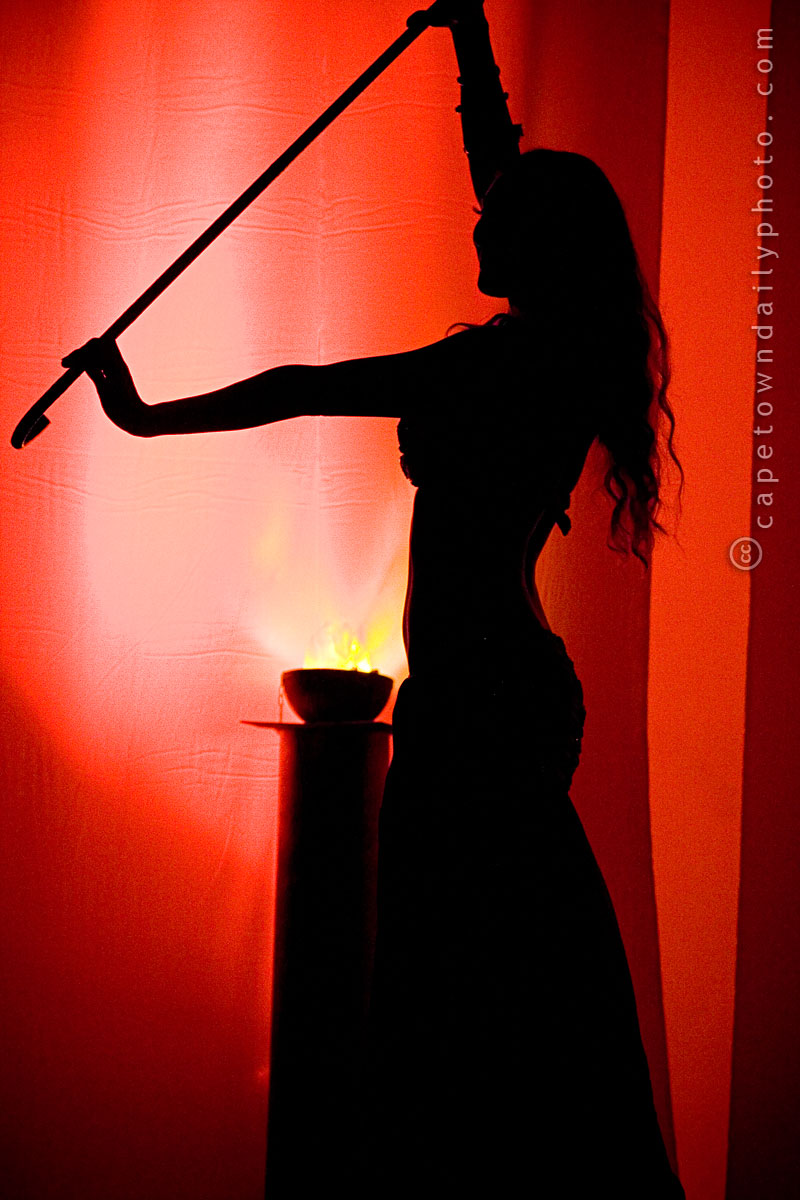
This is only the first sample of the photos to come (I'm busy working through the 500 photos I shot!); this genteel yet slightly cheeky cane dance was performed by the studio's teachers towards the end of the show. All in all, the show was spectacular, and I guess can be summed up in the words of Anais Nin (taken from the Feminine Divine website): "There came a time when the risk to remain tight in the bud was more painful than the risk it took to blossom.".
I have the impression (right or wrong) that guys in many other countries visit "the barber" to get their hair cut, beard trimmed, and nose-hairs snipped (*eeuw*).
For a few reasons, I've never visited a "barber". The one is that the thought of having a stranger who's a guy so in my personal space is a little weird, and the other is that there are very few men-only salons around these days. Apart from these reasons, given the option of a guy tending to your needs versus a beautiful woman... erm, don't you think the latter wins hands-down?
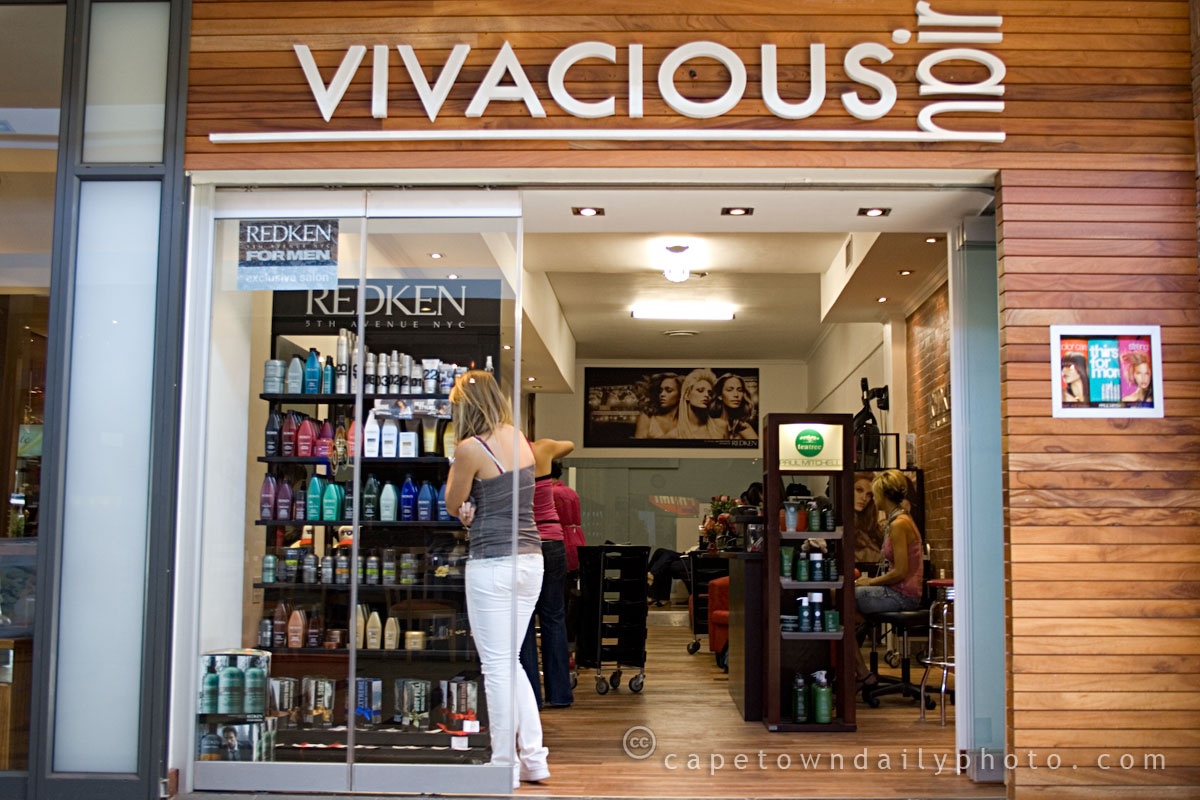
Kerry-Anne and I have our hair snipped and trimmed by Mariechen-scissorhands, the owner of Vivacious Hair in the Willowbridge shopping mall. What's cool about Mariechen is that she's down-to-earth, unpretentious, and snappy with the scissors. :)
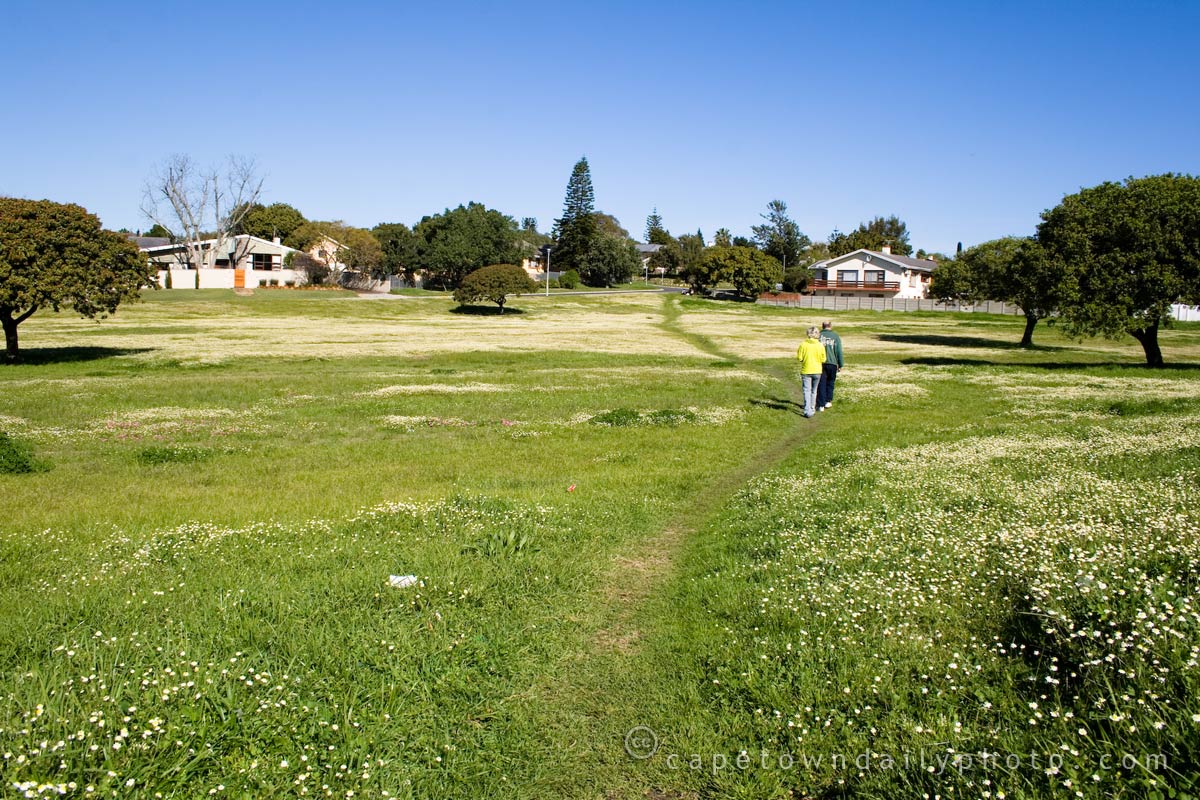
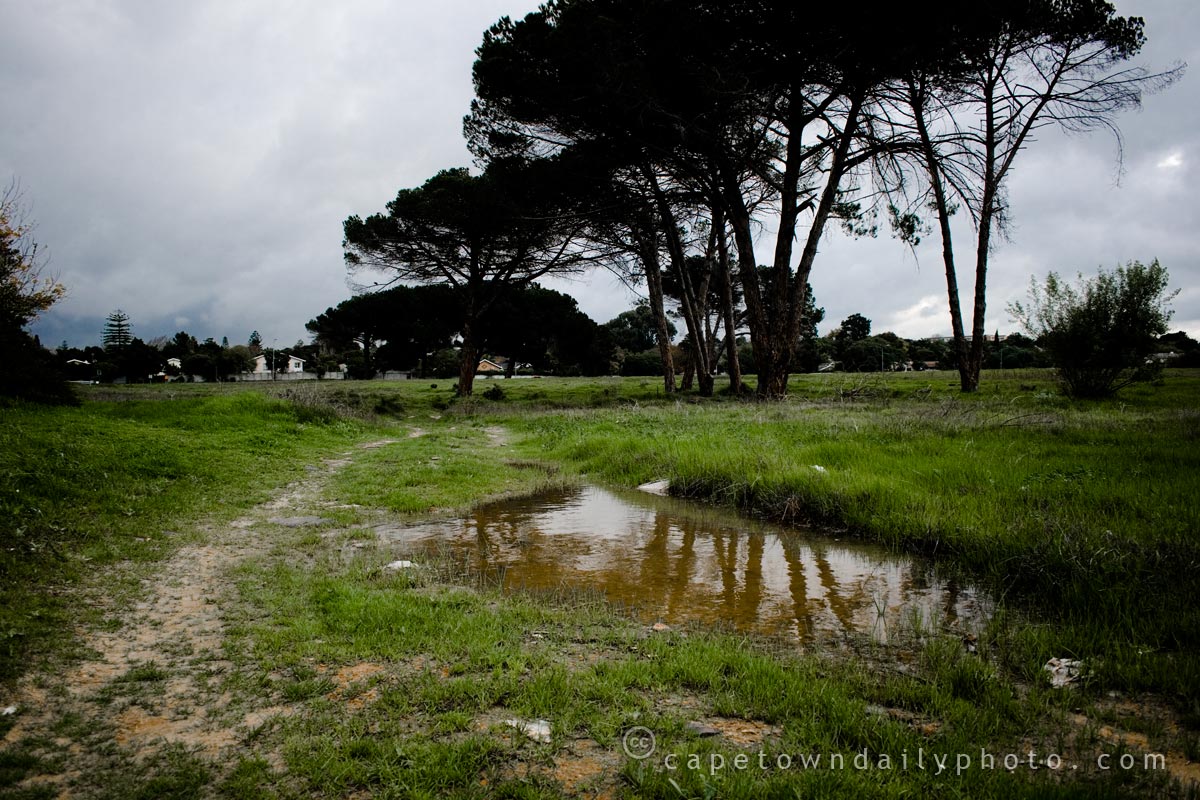
Pathways like this one aren't predetermined by a "field pathway engineer" - they develop organically as people make their way from one point to another. Normally it's pretty clear that the pathway leads to some common gateway or meeting place.
What is interesting is that while one may expect the pathway to be straight they tend to meander to their destination. Perhaps I'd understand this if the same person walked the route each day, but this path was made by a variety of people. What made them all meander in this particular pattern? It's not like there are hills or other obstacles in the way.
Is it only me, or is this kinda crop-circle-strange?
As I walked past this car I had to smile at the sticker on the rear window. The word "gifappeltjie" can be translated as "small poison apple" - which I guess could refer to the small car on which the sticker finds itself, or perhaps even the driver.
What I found interesting about a "gifappel" (of the genus Solanum) is that it's known by the names "Apple of Sodom", "Devil's Apple", "Poison Apple" and a variety of others. Some sites indicate that it's a treatment for all kinds of ills, while others claim it can be used to poison arrows. I even came across articles claiming evidence that it can be used to fight skin-cancer.
It seems as though the exact effect is determined by the species of Solanum. So, unless you know exactly what you're doing, I don't suggest that you go experiment with the medicinal properties too readily. ;)
One of the most fantastic we-don't-have-time-or-inclination-to-cook-a-meal foods is freshly battered and deep-fried hake with a huge pile of "slap" (pronounced "slup" and meaning "limp" in English) chips.
Do you know the kind that I mean? The kind of fish and chips that you just can't buy in a restaurant. The kind of fish and chips that comes bundled in large pieces of newsprint paper. The kind of fish that's covered in a crispy batter with the kind of potato chips that are soft, thick, salty, and laden with vinegar.
In yesterday's photo I drew attention to one of many pieces of litter littered about in a nearby field. Today our photo focuses on a different, and possibly more damaging, form of environmental damage. Yes, you have it, fossil fuels. This fuel tanker was headed for the Caltex oil refinery in Milnerton where it was presumably to pick up a consignment of diesel or petrol.
What I've always found strange is that for years we've all heard about hydrogen-powered cars and cars powered by water, but it seems as though petrol- and diesel-power still flourishes. For years the world has voiced concern over the environmental impact of fossil fuels, but clean-energy vehicles never seem to take hold. Even vehicles like the Toyota Prius aren't great for the environment... well, at least not the first few iterations (read more here).
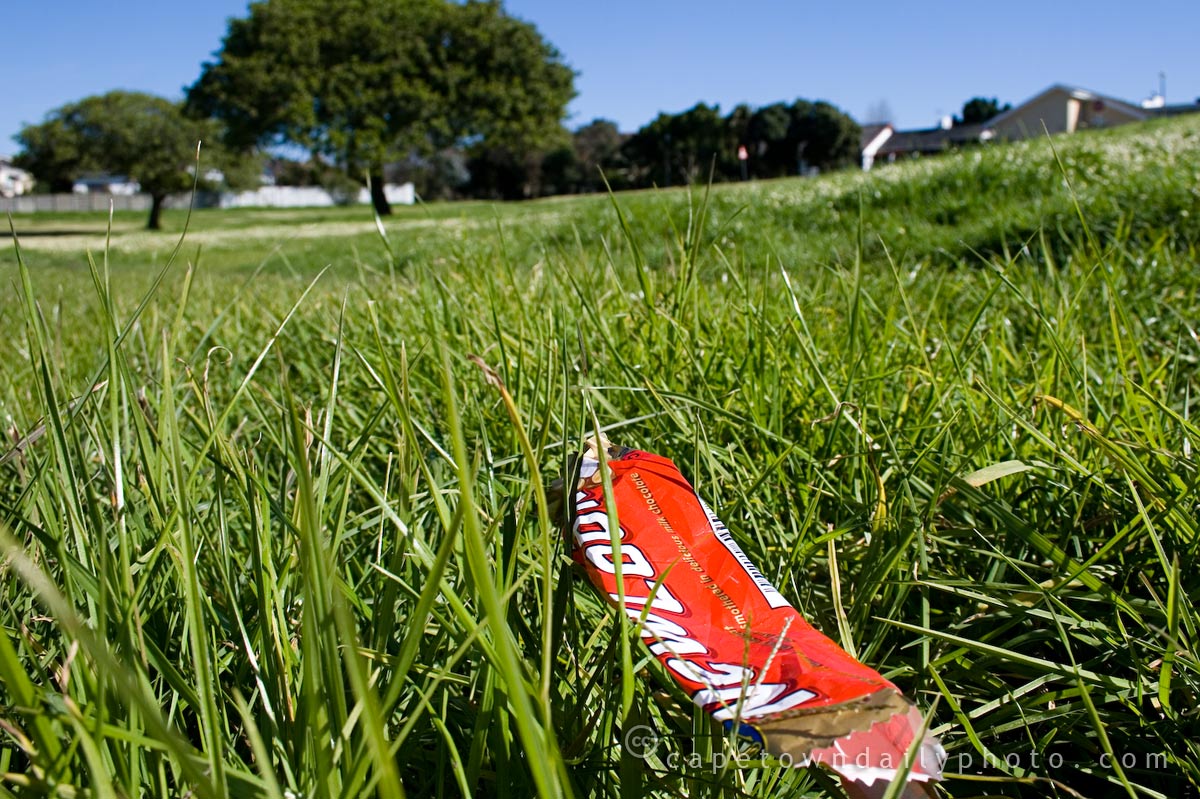
I took this photo while walking back home after leaving the Kwikspar (mentioned in my last post). Whilst the field's not a complete litter dump, I found it annoying that every now and again I came across of a piece of careless litter like the one presented in the photo.
Even as a kid I would never have dreamed of throwing my chocolate wrappers on the ground. Even if they fell by accident I'd pick them up. Even if the wind blew them beyond reach, I'd chase them down. Why is it that some think it's okay to not take care? Do you think it's that they simply don't think about what they're doing? Do you think that they believe that someone else should chase after their rubbish because they're too awesome to have to deal with it?
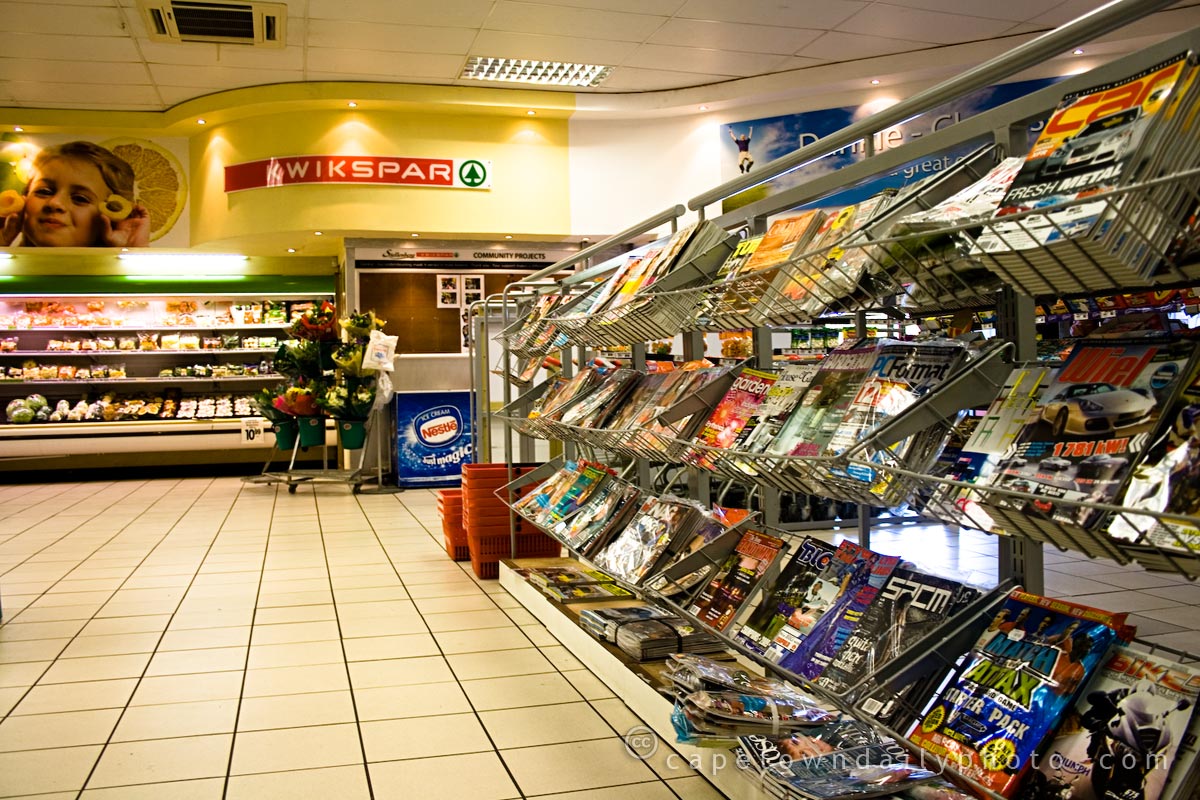
Instructed to find fresh bread, rolls and a pack of very lean bacon, I hurried over to our local Kwikspar, which is only a short walk from our house and (for the record) is one of the best Kwikspars that I've ever shopped at. The staff are normally pretty friendly, and the managers are even more so. The shop is always clean and tidy. The veggies look pretty fresh. The meat is of pretty good quality. There's always a variety of fresh bread and rolls.
I've found myself buying more bread from the Kwikspar's bakery lately. For the last few years we've been buying a brand of "toaster bread" that's manufactured in bulk by large manufacturers. What started to concern us about this bread is how long it lasts... I mean, is it normal for bread to last 2 weeks and still be soft? When we thought about it we remembered that when we were kids bread bought on Monday was stale by Tuesday... and I think this is the way it ought to be, else there's something terribly wrong with the substance we call bread.
As I said, lately I've been buying fresh rolls and bread from the Kwikspar... and I can definitely say that it's way better than the artificial bread we were previously buying. I mean, what's better than a thick slice of warm bread with a chunk of butter? Yum!
Before anyone else settled in the Cape, the Khoi and the San (perhaps known more widely as the Bushmen) inhabited the area. Eventually, in 1652, the Dutch East India Company sent Jan van Riebeeck to establish a supply station at the Cape - and I guess this is where the battle for land and rule officially began (at least between Europeans and Africans).
Here's an interesting piece of information that I'm surprised I'd never considered before: before Table Mountain was named as such by the Portuguese admiral António de Saldanha it was known by the native inhabitants as Hoeri ‘kwaggo - or Sea Mountain. Given its location, I guess this makes absolute sense; though I guess at the time António must have misinterpreted his hosts' hand-signs and gesturing.
This month's GeekDinner was held at The Pasta Factory, a restaurant in Park Road, Cape Town. We really enjoyed the venue - it was open, people could hear and see the speaker easily and it was easy to mingle with other geeks and wannabe geeks. :)
The talks ranged from Joe's talk on spectrum (as in wi-fi spectrum) and how we need to conserve and optimally use it, to the viciously entertaining slideshow karaoke by Elodie on how to charge batteries using other batteries. (In slideshow karaoke, the "victim" has to give a talk based on someone else's set of slides, which they've never seen before. The results are always rather amusing, as you can imagine.)
All in all we had a great evening - helped along by plenty of good wine (kindly sponsored by Delheim), as well as a few Jägermeister shots. ;)
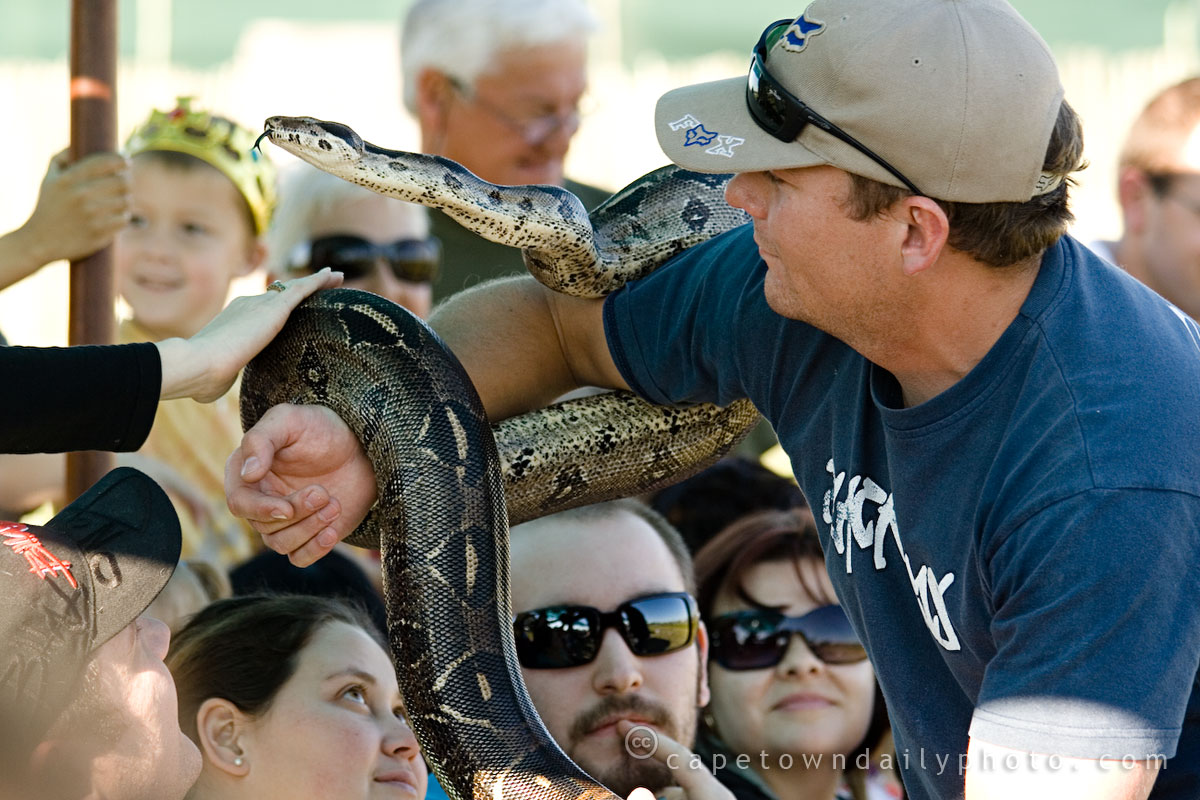
Apart from the album that I've uploaded, this is the last of the photos that I'll post from our visit to The Giraffe House. Boa Constrictors aren't native to Africa, but I thought that I'd post this photo because the snake show/educational was so interesting. I'm not a parent, but what was nice was that the snake handler in the photo engaged with and invited kids forward to touch and hold snakes - yup, even this large Boa Constrictor.
One of the interesting things that I learned was that Boa Constrictors are often kept as pets and each year several owners are killed by their friendly slithery snakes. Boas are classified as constrictors, and contrary to what you may think, they don't actually crush their prey, they suffocate it. Each time the animal (or... erm... human) breathes out, the reptile tightens its grip so that the prey is unable to fill its lungs properly. Eventually the victim is unable to catch a breath and suffocates. So... DON'T BREATHE OUT! :)
One of the other interesting things that we were taught is that if a snake is coloured with red, yellow and black, the rule of thumb is that if the red scales touch the black scales then the snake isn't poisonous [*see edit below], but if red touches yellow... you should probably back off. The handy rhyme goes:
"Red touching black - poison lack; red touching yellow will kill a fellow."
EDIT: Please see my the comment below which corrects what I understood the handler was meant by red/black and red/yellow.
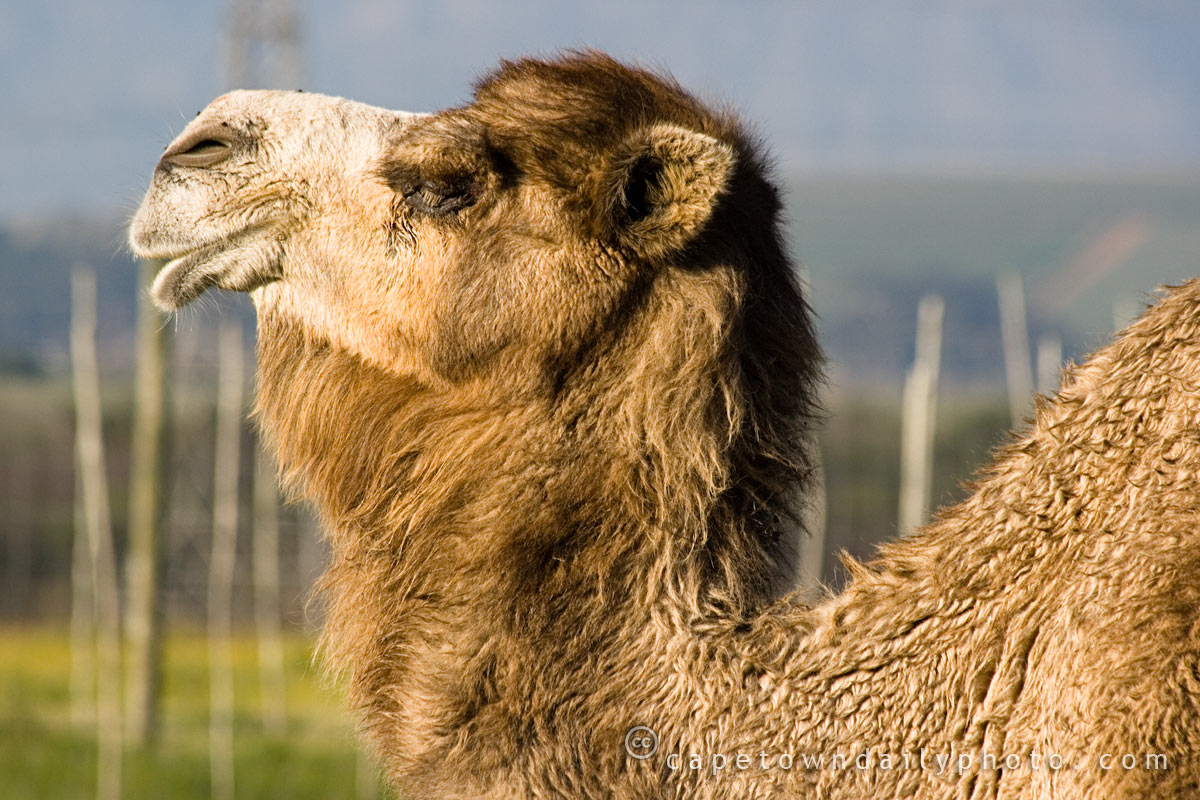
Pete (that's our name for the camel we found at The Giraffe House) is a Bactrian camel - meaning that this fellow is of the two-humped variety.
The Bactrian Camel is apparently one of only two species of camel, the other being the Arabian, or Dromedary, camel. What I found interesting is that there are only very few camels in the world that are not domesticated. The weirdest thing of all is that it seems as though the camel is the only land mammel able to drink salt water without suffering ill effects!
One of the fun things you can do in Cape Town is to take a ride on a camel: Imhoff Farm offers short rides around the farm as well as a 2-hour-long "Bush Ride", which I hear is loads of fun.
If you've ever taken a ride on the Imhoff Farm camels, please leave a comment and tell us what your experience was like (as well as any tips that one may find useful on a 2-hour-long camel ride!). The only camel ride Kerry-Anne and I have taken was a short one on an Arabian camel while on honeymoon many years ago.
There we were, at The Giraffe House, and unbeknown to us we had a famous actor in our midst. According to iAfrica, baby Gerry is a star in the soon-to-be-released movie Free Willy 4. At the time I wondered why she immediately rushed over to us when I pulled my camera from my bag! To think that she's only just over a year old and already a star! Kids grow up so fast.
On a more serious note, it's worthwhile taking your kids to see the few animals at The Giraffe House, especially since they have "animal encounters" each day at 11h00, 13h00 and 15h00, showing snakes, birds, tortoises, a speedy caracal (called Felix) and the perhaps the coolest of all, Gerry’s 16-litre bottle-feeding.
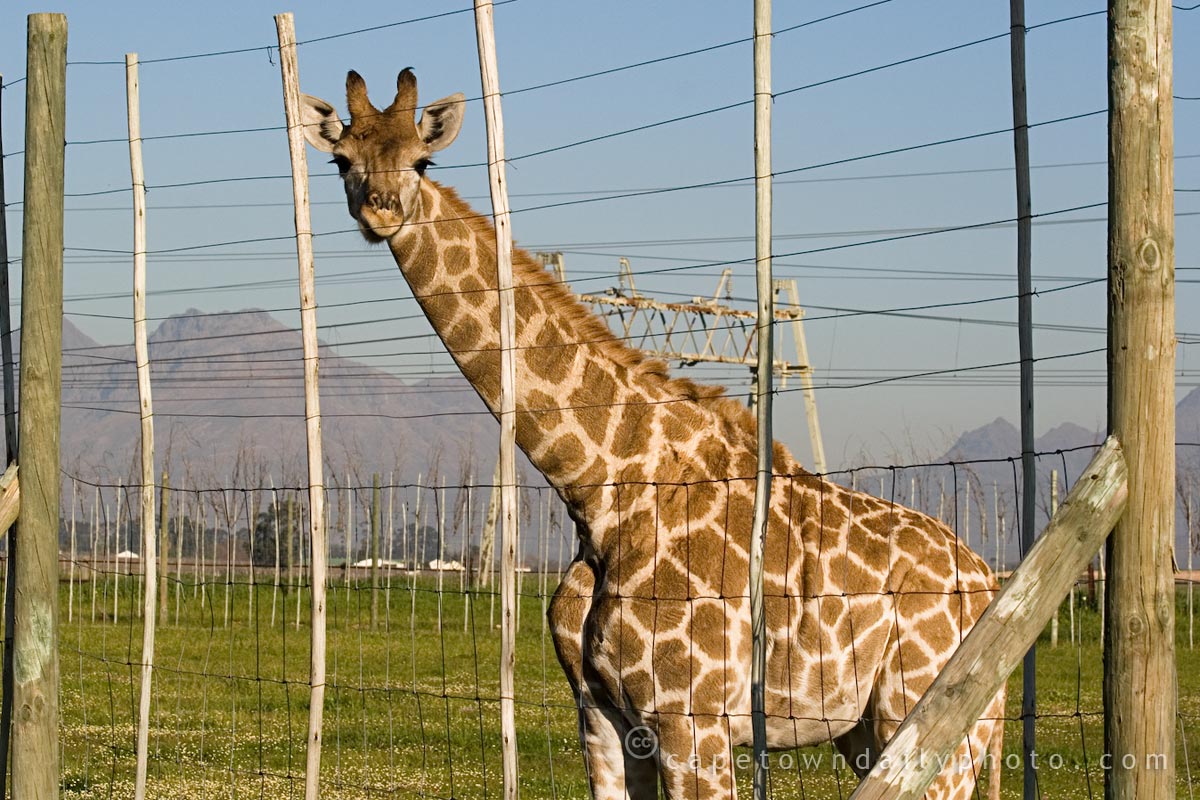
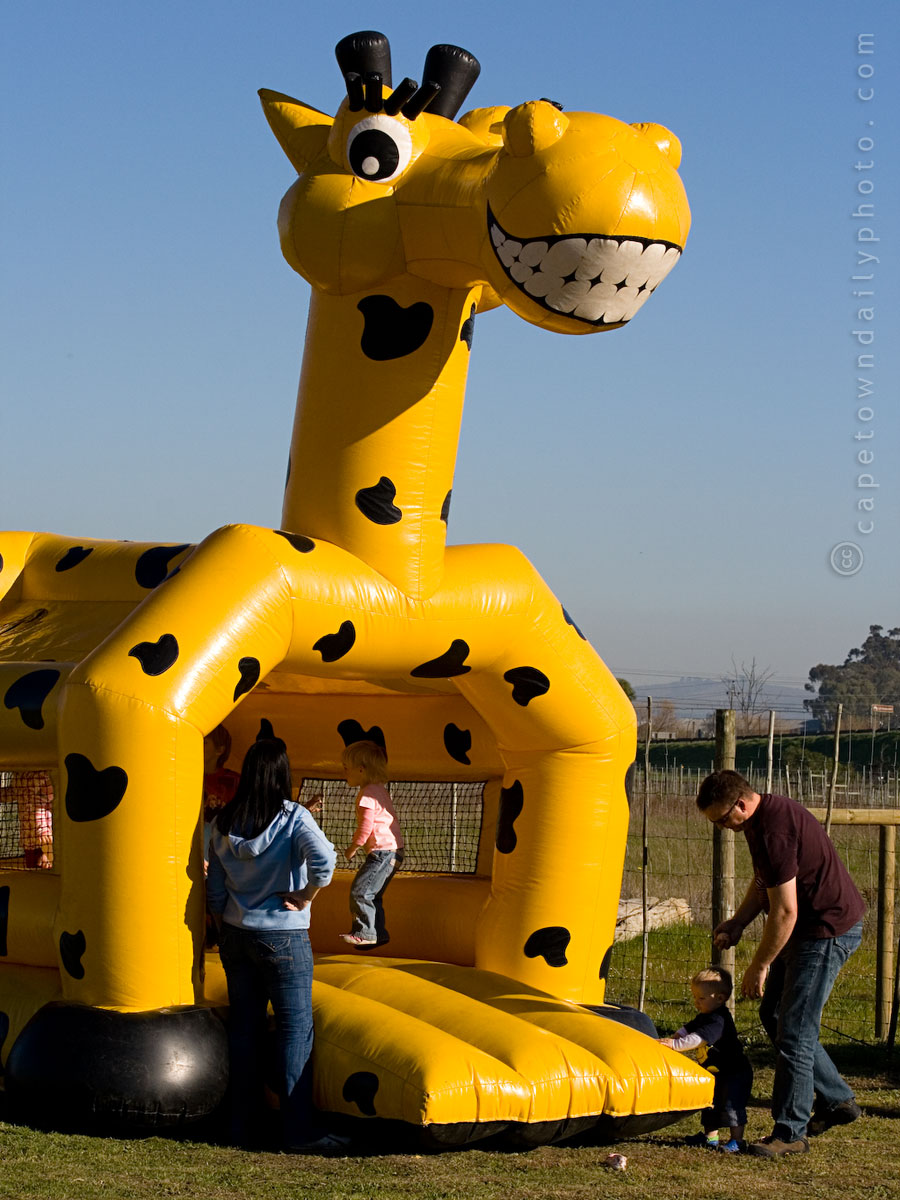
Not only does The Giraffe House have this bouncy plastic giraffe (don't you love his smile? :) ), but they have a real one too! Right here in Cape Town, just down the road from Stellenbosch! I did catch a few (well, actually plenty of) shots of the tall and timid animal, but that I'll show you in Monday's post.
We've been meaning to visit The Giraffe House for some time now, so when we were given the choice of going to our godchild's 6th birthday party HERE or a "boring adult cake-and-tea"... erm... there was no contest. Definitely, The Giraffe House! The cool thing about the place was that they don't only have a giraffe, but also an assortment of other animals, some of which I'll show you on Tuesday and perhaps Wednesday.
Thanks, Ethan, for having a birthday and convincing your mom to take us all to The Giraffe House!
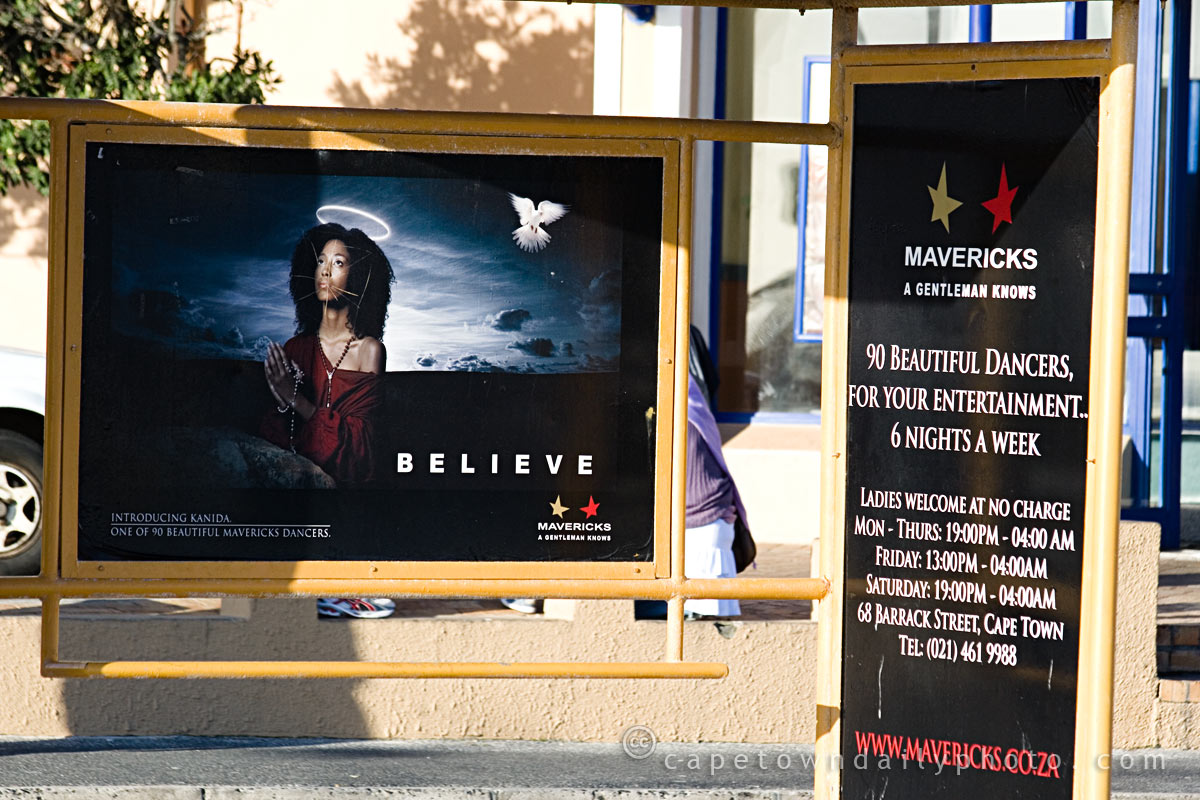
Now if Mavericks were spelled with an apostrophe-s then I'd say your chances of finding Tom Cruise here would be small to good. In this case however, there is no apostrophe, and Mavericks is indeed - as I'm sure you can gather from this billboard - a strip club.
I've no idea how many such clubs there are in Cape Town. The only two that I can remember ever seeing are Mavericks and Teasers... and I guess this is because they're the only ones that I've ever seen advertised.
I clicked on over to the Mavericks(careful, PG-rated content) website to see what it's all about, and noticed two things. The first is that the place looks stylish and has a red Moulin Rouge feel and atmosphere. The other thing that was apparent is that most of the ladies working at the clubs are from Eastern Bloc countries like Russia and Lithuania. In fact, the "dancer application form" is downloadable in two languages, English and Russian!
Constantia Nek Restaurant, the oldest in Cape Town?
According to their website, the Constantia Nek Restaurant is the oldest restaurant in Cape Town. I think that my mother would contest that as she often feels like her kitchen is the oldest restaurant in Cape Town. ;)
Seriously though, I can't confirm whether or not it's true, but based on the fact that the restaurant is in a spot secluded from the city's development I guess that it's possible that the restaurant is the oldest surviving restaurant in Cape Town. I have to be honest and say that we've never had dinner there, but I do remember stopping by for a couple of beers while watching a friend of mine play guitar in a band.
Back then the inside was decorated old-style, with benches that you'd expect to find in an old English tavern. What was really cool about the place was that they had extra-warm (that's slightly warmer than warm) fires burning inside to keep the place nice and toasty during winter evenings. While I stood outside taking this photo, I could hear voices and laughter emanating from the building - it would seem as though that warmth lives on, fire or no fire.
Pardon me for today using this old photo from my helicopter trip on 8 July. Based on the title of this post perhaps the reason is fairly obvious to you though. Or, perhaps you haven't heard that Table Mountain is one of the finalists in the New 7 Wonders of the World campaign?
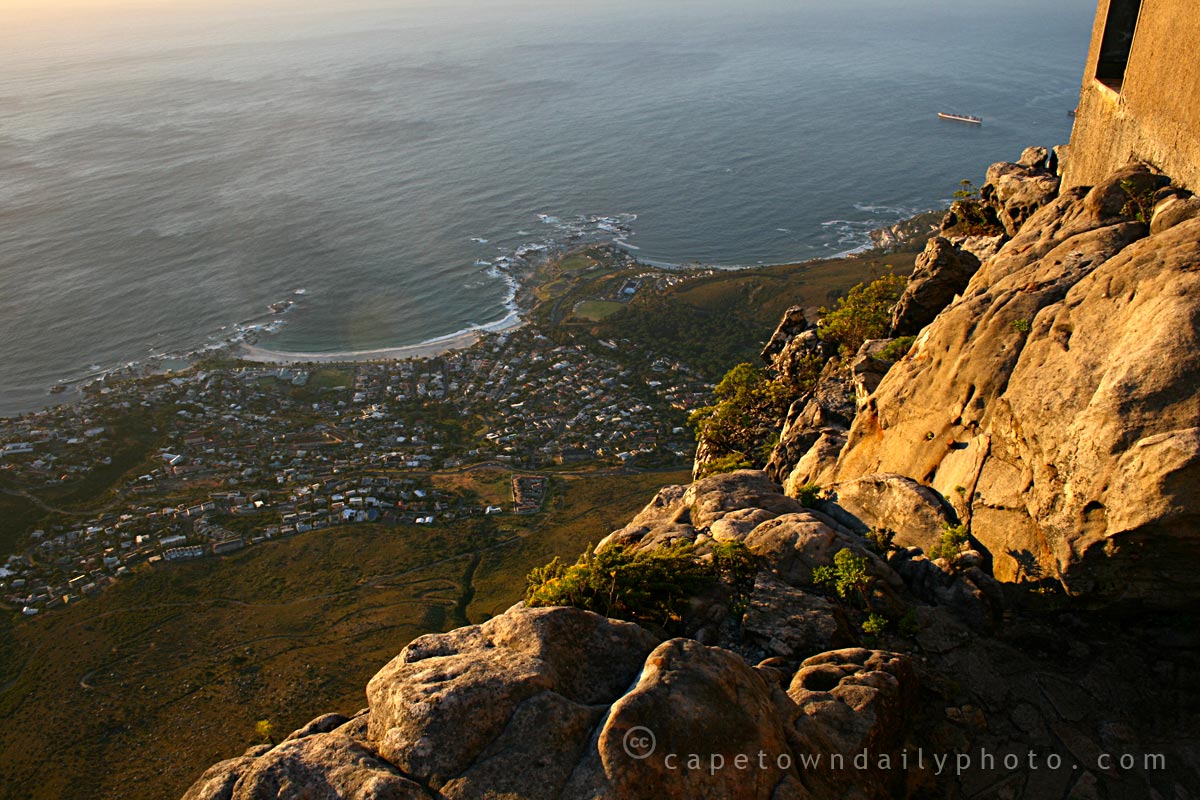
Please take some time to click through to the official website where you can cast your vote for what you consider to be the 7 top wonders of the world. (Hopefully Table Mountain will be one of them, but if for some reason you're not convinced by this photo, take a look at a few of the reasons at southafrica.info or get a better perspective by taking a look at thesetwo photos taken from the summit. :) )
Head over to the New7Wonders website, click on the photos, add the 7 that you consider most deserving to your list, and follow the step-by-step instructions. Simple!
In closing, first do the voting thing; but when you're done, if you're interested in seeing a few of the photos from my exciting helicopter trip, click through to the photo album that I put together for the ship's crew.
Over the last few days I've been posting photos from the Worldwide Photo Walk that I attended on Saturday. Even though Cape Town was at her best on Saturday, and there are plenty more photos that I'd like to draw your attention to, this will be the last one that I'll publish as a blog entry. I have however uploaded the rest of the morning's photos to our "Scott Kelby's Worldwide Photo Walk - 2009" album. Please indulge me and take a look through the album - the city really was very photogenic on Saturday morning.
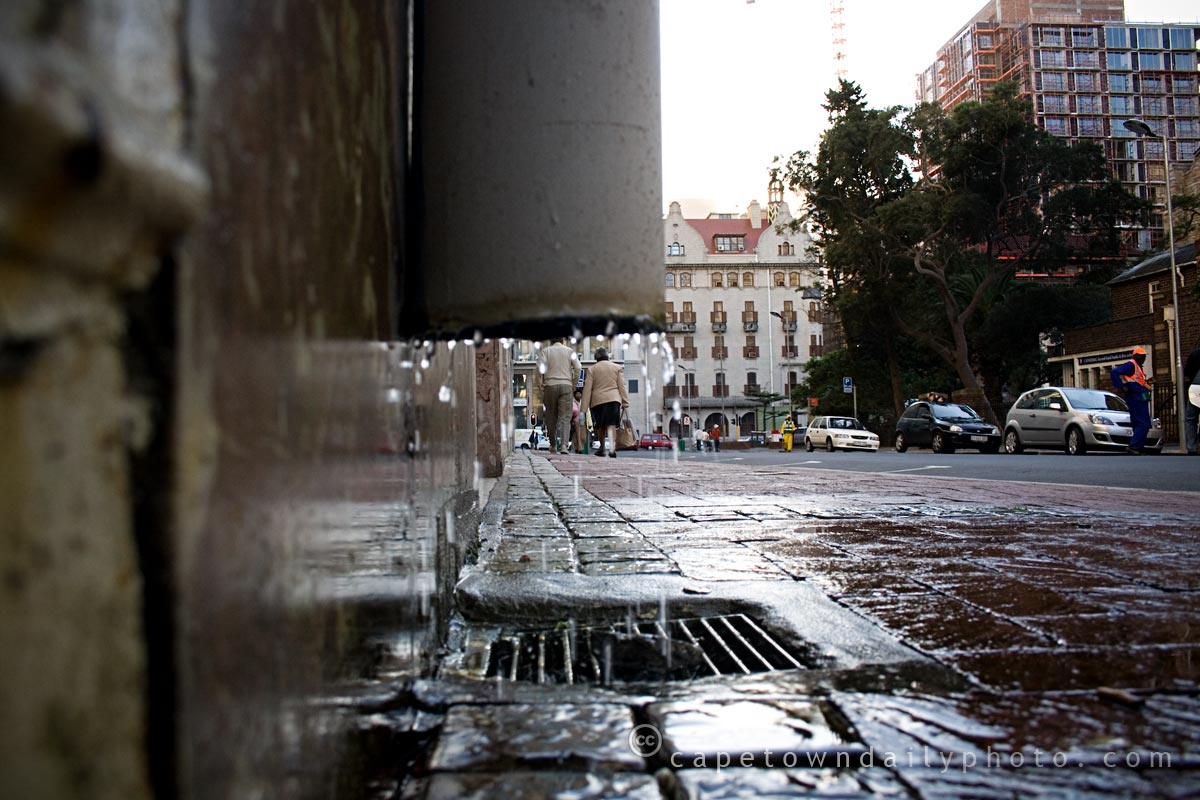
On a side note, although we had perfect weather on Saturday, I found this gutter downpipe dripping really fast, almost as though it were raining... which makes publishing this photo today co-incidental since this week we've had our fair share of rain! Perhaps the dripping was prophetic in some or other way? :)
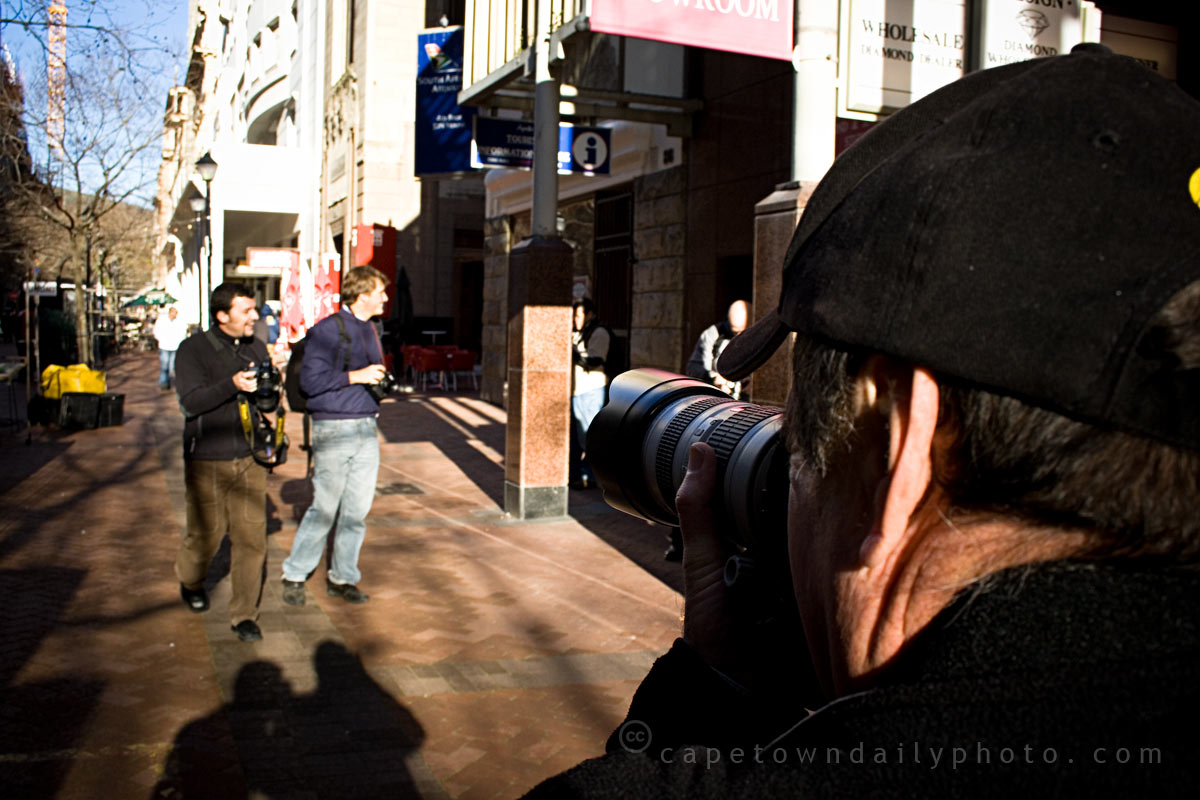
I must have some kind of fetish for taking photos of photographers. Not 'that' kind of fetish, understand? I caught a photo of Mr X (never got his name) taking a photo of two other photographers, Leon (walk leader) and Mr Y (never got his name either) in our Worldwide Photo Walk group. I guess one could call this meta-meta-photography!
What you see in the background is St George's Mall - an open-air shopping mall with several restaurants, and most importantly a Vida E Caffé, a well-known and well-loved coffee shop franchise.
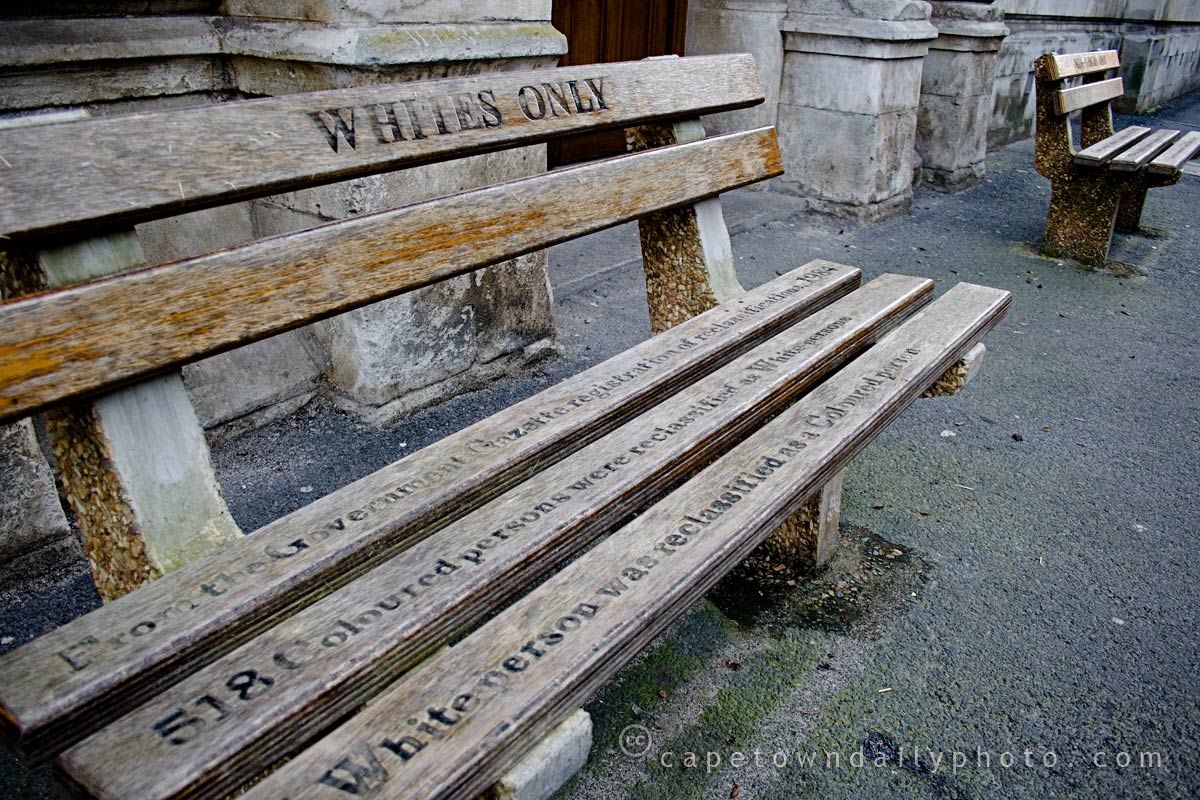
I captured today's photo at the doors of the Cape High Court in Queen Victoria Street, during yesterday's Worldwide Photo Walk. The plaque next to these two benches reads:
"In the 1960s a room in this building was the scene of hearings of the most bizarre and humiliating kind as ordinary people came before an appeal panel to argue about what 'race' they should be labelled. Between 1950 and 1991 apartheid's Population Registration Act classified every South African as belonging to one of at least seven 'races' - and accordingly granted or denied citizenship rights on a sliding scale from 'White' (full rights) to 'Bantu' (with the fewest). The classification was subjective, and families were split apart when paler or darker skinned children or parents - or those with curlier hair, or different features - were placed in separate categories."
- The Times
Don't you think the word "bizarre" describes this practice fairly accurately?
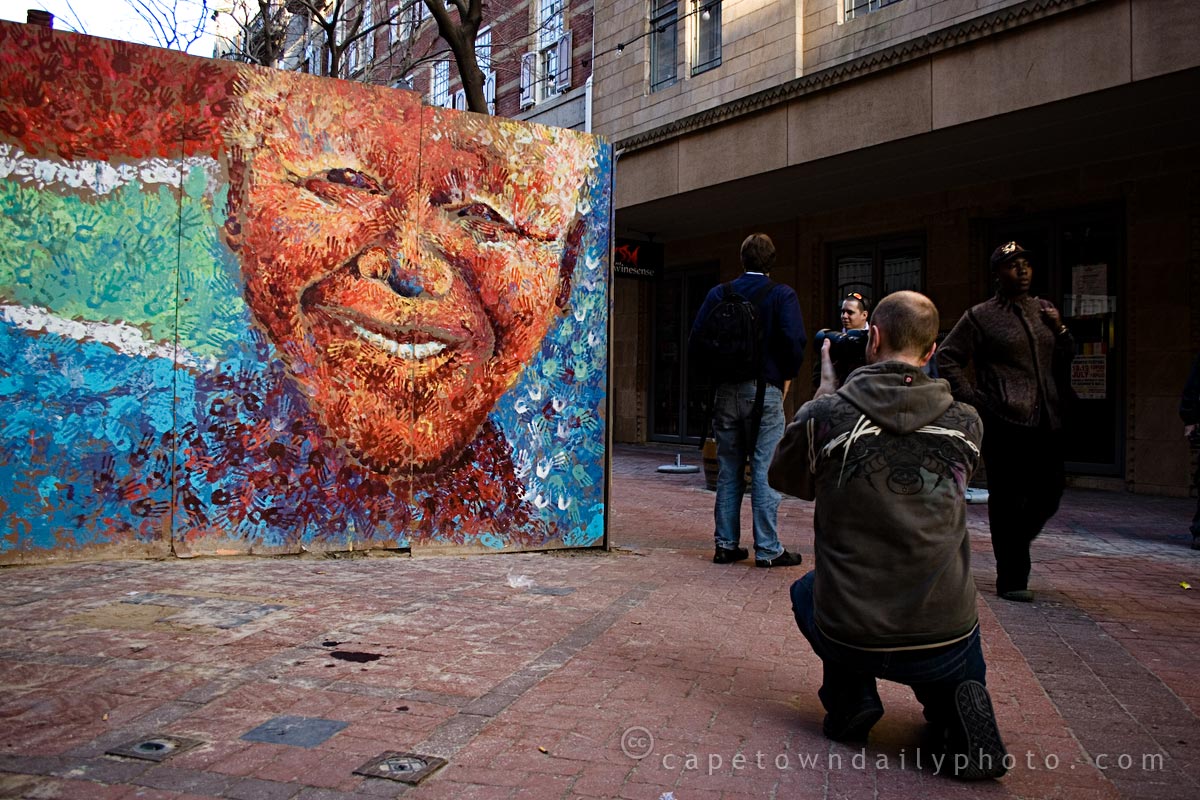
As many of you will probably know, today is Nelson Mandela's ninety-first birthday. Co-incidentally, it's also the day on which groups of photographers took to the streets of their towns and cities armed with cameras, to take part in the second global Worldwide Photo Walk.
After our late night at Wakame, I momentarily regretted signing up for the walk, as it meant getting up in time to meet the rest of the group near the planetarium in Cape Town at 8am. But somehow I dragged myself out of bed, drove through to town, and met up with a group of about 20 photographers. We spent the next two to three hours walking the streets of Cape Town, spending quite some time in the well-known open-air St George's Mall. In retrospect I was glad that I didn't bail on the outing - the weather was fantastic, the other photographers were friendly and fun, and there were almost too many great opportunities for photos.
We'll be posting more of the photos from the walk over the next few days; but for now, let me close by wishing you, Madiba, a happy birthday and brilliant next year!
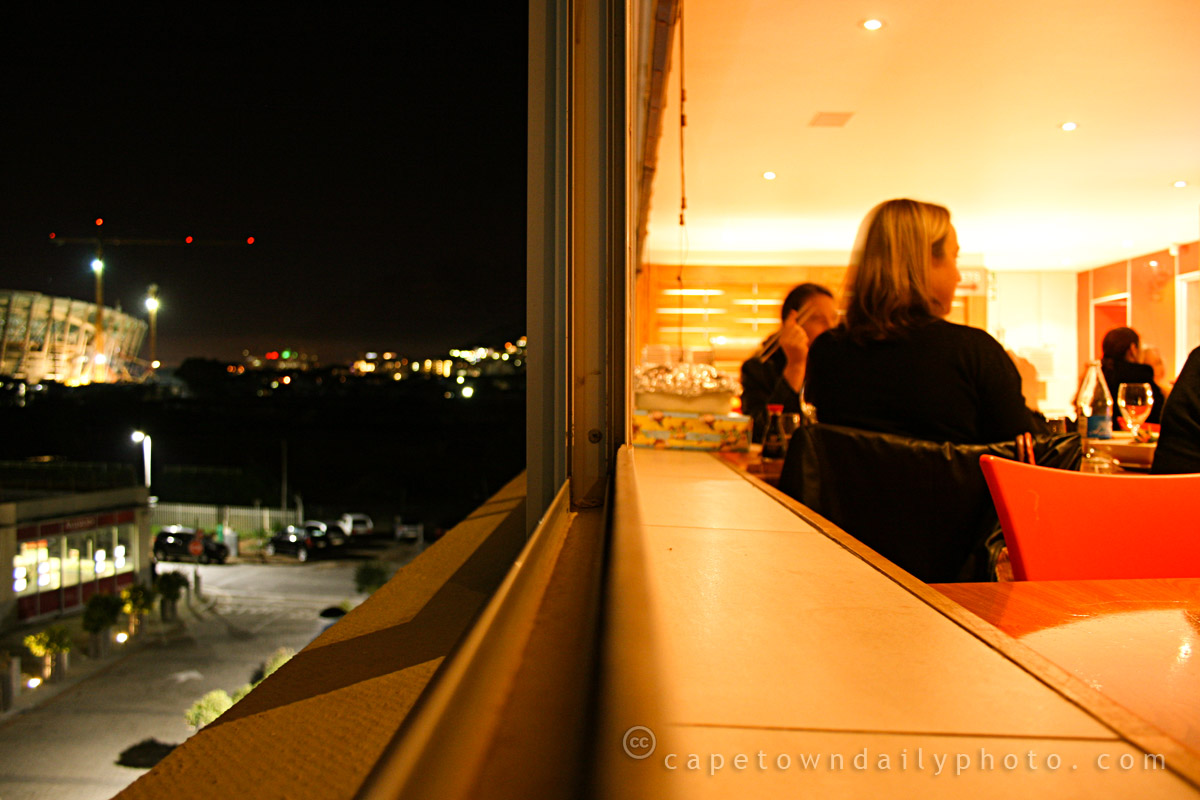
At least one of our UK readers in particular will immediately recognise the inside of Wakame, a popular tapas and sushi restaurant in Mouille Point, located very close to the Green Point soccer stadium. In fact, the stadium is precisely what you can see brighly lit out in the darkness.
While we were enjoying really (very) good sushi, I watched welding sparks dropping to the ground from the structure in the distance. It would seem the stadium's construction workers are putting in some serious overtime to catch up after last week's wage dispute.
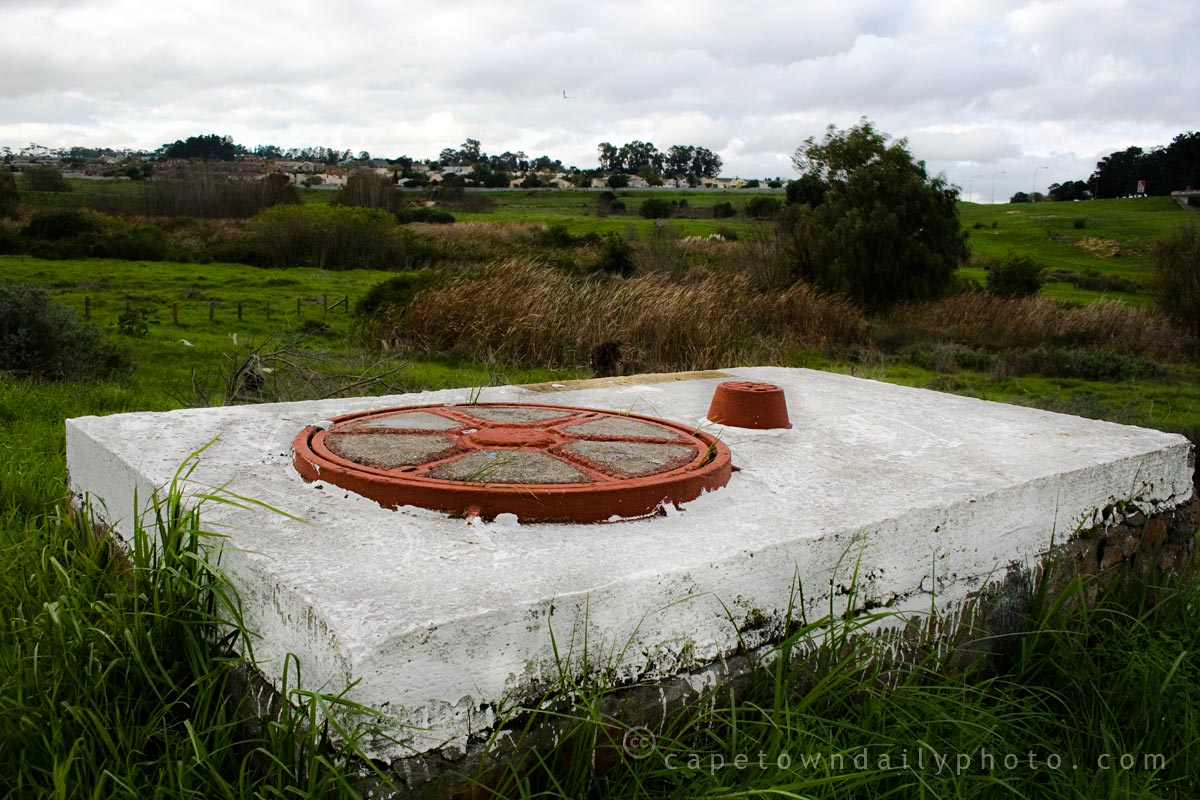
Ever since I was a kid I've been curious to know what lies beneath holes like these. When I was young I remember playing in stormwater pipes not far from my parents' home. I remember walking below the streets watching people pass by from beneath the drains in the road. Fortunately for my brother, sister and friends we had sense enough not to play in the tunnels when rain was imminent, but still, I sometimes shudder at the danger we put ourselves in. Not only was there the possibility of being trapped by some kind of freakish flood, but there could have easily been freakish people wandering the tunnels too.
A few years after leaving home, I noticed that the municipality had erected heavy iron grids in front of the entrances. I do hope this was in response to residents' complaints, and not as a result of some unfortunate incident. To be honest however, I suspect it was because the cops got tired of chasing baddies down the tunnels! :)
As Kerry-Anne wrote, it's been raining buckets in Cape Town. In addition to the rain though, it feels like it's been getting colder and colder with each passing day. As I write this post I'm wearing two pairs of warm pants, two pairs of socks, and four long tops - an unusual outfit, you must understand. I did a quick scan on our weather page and noticed that of the five weather stations that we monitor, the closest one to us (Durbanville Central) is the coldest at 9.2°C! Now, I know that 9.2°C isn't very cold for many of our readers, but you should remember, this is Africa!
We've often been told by visitors from abroad that the difference between South Africa and other cold countries is that our homes aren't geared for cold weather. We don't have particularly well-sealed windows or doors, I don't have a warm fire burning, there's no central heating, and nor do we have that awesome underfloor heating that a few of our friends are no doubt enjoying right now.
If you do find yourself visiting our city over winter, while you don't have to bring your snow gear along, do bring enough warm clothing, because it does get chilly every now and again.
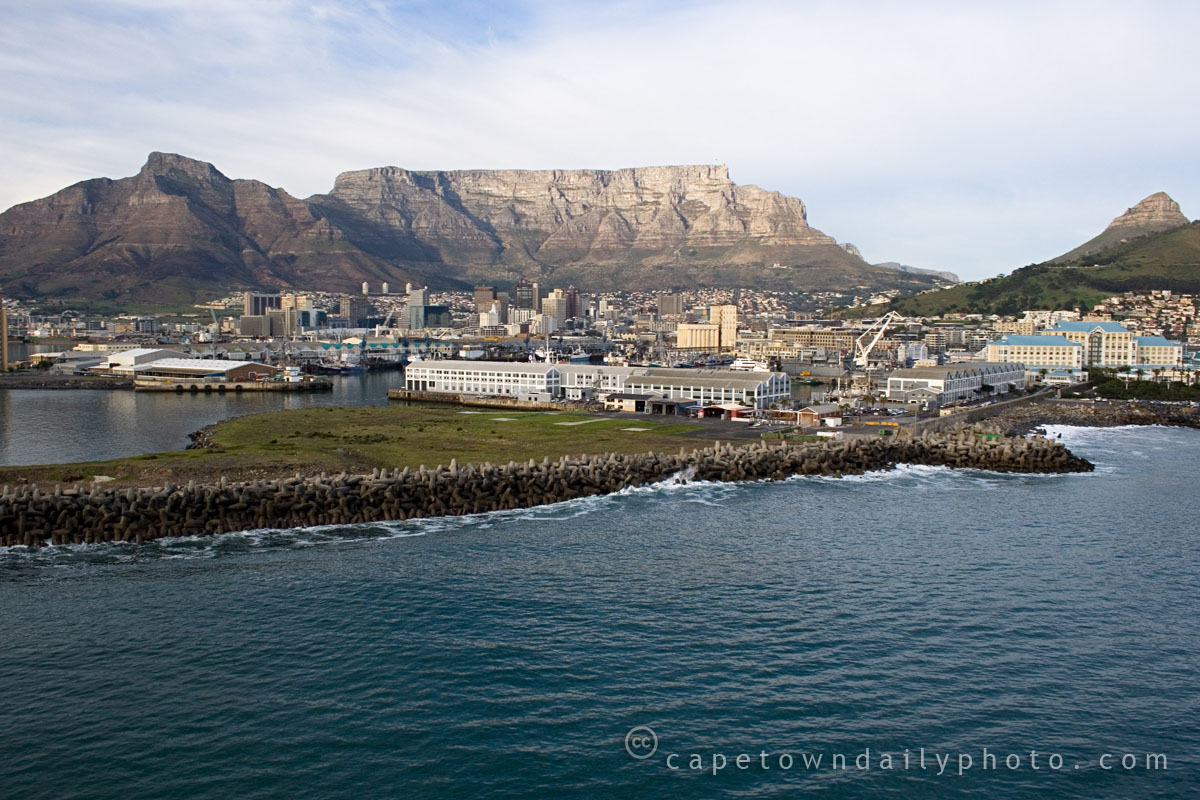
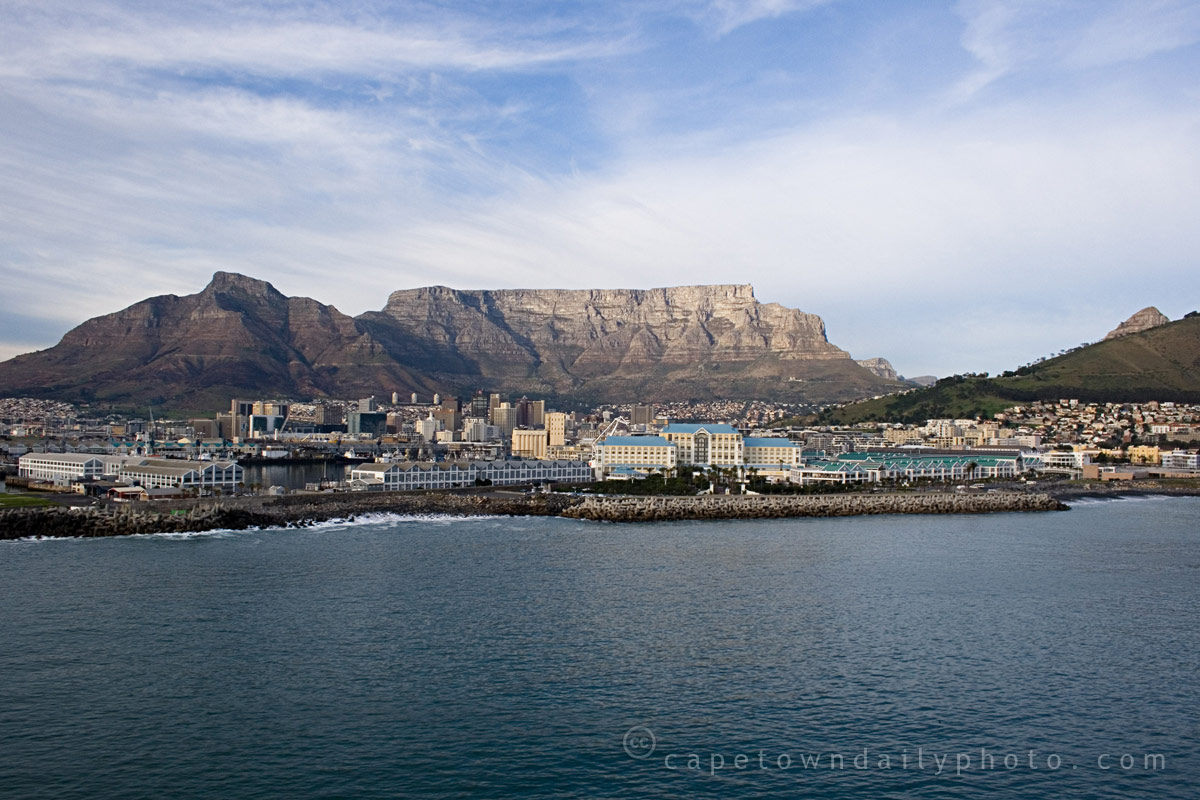
This will be the third and last daily photo from my spectacular-spectacular helicopter trip over Cape Town's Table Bay. Shot while we were coming in to land, what you can see in this photo is (obviously) Table Mountain in all her splendour, and right in the middle the well-known Table Bay Hotel.
What struck me as interesting in this photo is how large Devil's Peak (to the left) appears to be when compared to Table Mountain. At 1 kilometre in height, it's only 87 metres shorter than Table Mountain, making it a fair-sized piece of rock! Visit the Wikipedia page about Devil's Peak - they have an awesome panoramic photo taken from the peak's summit.
P.S. After my little helicopter expedition I've decided to make a concerted effort to do more aerial photography around Cape Town, so if you want to pay someone to fly around the Cape, you know who to call. ;)
The mountains of Cape Town – a helicopter’s perspective
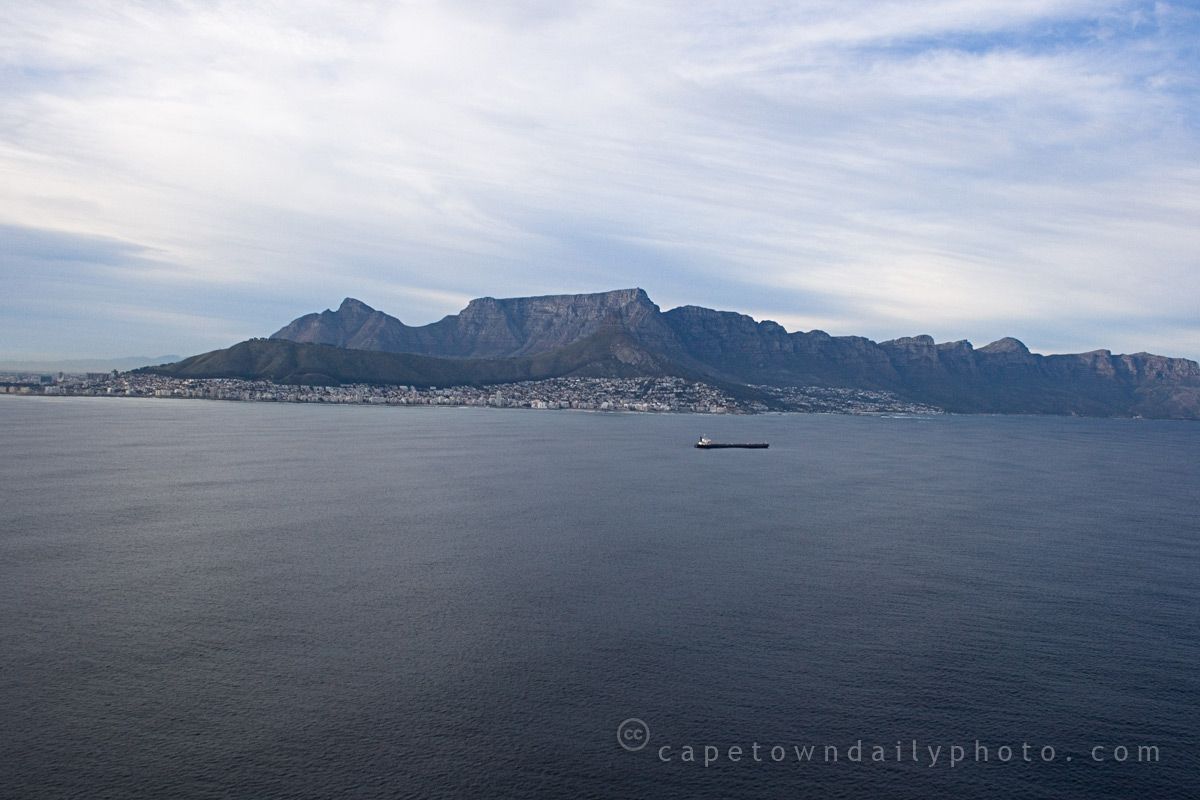
I guess you're all used to seeing the traditional Table Mountain photos, where it does in fact look somewhat like a table. I took this shot from a helicopter, after I'd spent about 50 minutes taking photos of two Tidewater Marine boats passing by Table Bay. Read yesterday's post for more info.
Since this isn't the traditional photo of the city, allow me to take a moment to point out which mountains, peaks and hills you can see here. Starting at the back, on the left is Devil's Peak, with Table Mountain to its right, kind of in the middle of the photo. You'll notice that it doesn't look as much like a table from this angle. If you click on the photo and view the large version you'll faintly make out the cable car station to the right of Table Mountain. Following on from the cable station, all the way to the right of the photo is the 12 Apostles mountain range (but, to be honest, I'm finding it tricky to pick out the 12 from this angle). In the foreground, you'll see Signal Hill (from where the Noon Gun is fired each day) on the left, with Lion's Head just to its right.
From this angle it's fairly easy to see why Signal Hill is often still referred to as "Lion's Rump".